
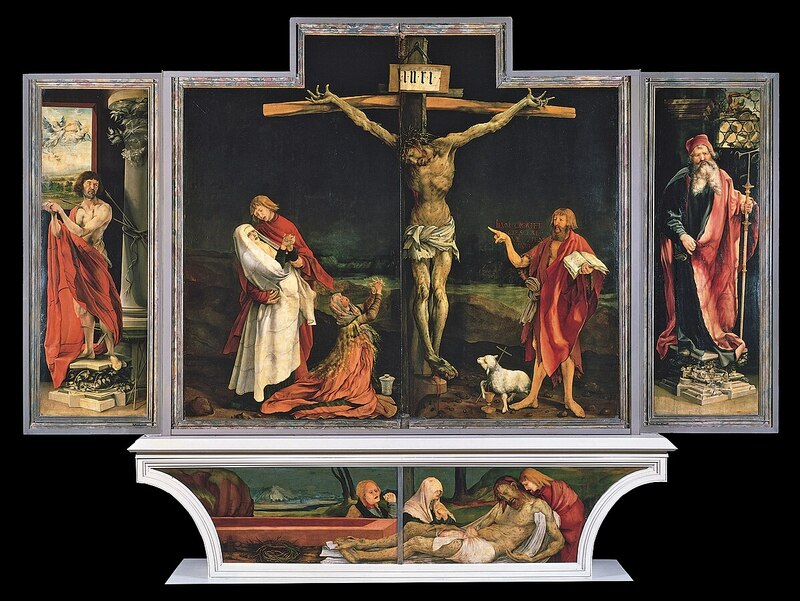
Image: Matthias Grünewald, Isenheim altarpiece (first view), c. 1512–1516. Unterlinden Museum, Colmar, France. The central panel shows John the Baptist pointing at the crucified Christ.
When I moved to Indiana in 2010, everything I owned fit in the back of a small UHaul truck. The largest items were a couch and a bed. I also had a lot of books and a couple bookshelves. But I didn’t have a lot of extraneous things. A couple knick-knacks. A childhood baseball card collection. A modest wardrobe. A 21” television. Some kitchenware, an IKEA table and dresser. That was about it.
Nine years in a four-bedroom parsonage showed me how easily stuff accumulates. Sarah and I got married and had a baby, which brought more stuff. Some things were given as wedding or baby presents. And some things just piled up over the years. A kitchen appliance here, more books there. A television here, a guest bed there. By the time we moved, I went from that small UHaul to a semi, packed and driven by professional movers.
Since moving to Alex, our war with stuff has become a losing one! In addition to our own home, we have to continue to deal with Sarah’s dad’s home, trying to find new places for his things. A lot can accumulate over a lifetime.
Which is as good an analogy as any for today’s sermon. Just as we need to do a physical housecleaning from time to time, we need to do a spiritual housecleaning as well.
John the Baptist would call such spiritual cleansing repentance. We find him at the Jordan River, helping people clear out the muck from their lives through his baptism. He drew many people who wanted a fresh start. Through this baptism of repentance, they would be prepared to receive God’s kingdom. And God’s kingdom is known fully in God’s Chosen One, his Messiah, Jesus Christ.
We hear of this Messiah both in the reading from Isaiah and in John’s own words. Isaiah tells us of the shoot from the stump of Jesse. Jesse, of course, was the father of King David. And David was to have an eternal dynasty. God promised such in 2 Samuel 7. But it didn’t seem to work out that way. When Isaiah proclaimed these words in the late 8th century BC, the Davidic monarch, Ahaz, was weak, besieged by other powers. He put his faith in sketchy foreign alliances over the God of Abraham, Isaac, and Jacob. In other words, he became like any other ancient king: corrupt, self-serving, and ultimately, self-defeating.
But God’s Chosen One is different. He is infused with God’s own Spirit. He doesn’t judge by appearances or by what is most politically expedient. He doesn’t seek to enrich himself. He doesn’t even rule by brute force. Even the most martial verse, verse 4, gives us that clue. “He shall strike the earth with the rod of his mouth and with the breath of his lips he shall kill the wicked.” In other words, this poetic language, along with the idyllic picture of the lion with the lamb, tells us that this is a king unlike any other. He doesn’t lead a conquering army. He doesn’t use swords or spears. He doesn’t employ guns, bombs, missiles, or drones. His one weapon is the Word of God, which he speaks in its fullness.
And that Word is a purifying fire, to use John’s language. John tells us, “He will baptize you in the Holy Spirit and fire.” That fire cleans out the chaff that accumulates in our lives: the grudges, the held-onto hurts, the grievances, the unforgiveness. That fire cleanses out all our sins, including and especially those same ones we keep committing repeatedly. Like the contemptuous attitudes we have toward certain others. Or the gossip we spread. Or other behaviors we’re addicted to. Jesus is the one who cleanses and purifies us from all that spiritual junk day after day, week after week. As the Small Catechism tells us, our baptism signifies “the old creature in us with all sins and evil desires is to be drowned and die through daily contrition and repentance, and on the other hand that daily a new person is to come forth and rise up to live before God in righteousness and purity forever.”[1]
Jesus makes us ready to receive him and receive his kingdom. We receive that through our own baptism. Baptism makes us a child of God, and the process of repentance that entails takes our whole lives. Whenever we come to church, we receive his means of grace that make that repentance possible. We confess our sins together. We hear his Word together. We receive his body and blood together. All that is cleansing fire for our souls, a spiritual housecleaning. When we receive him that way, we receive him as Lord within us. Such a reception is not usually the way the world works. The world works by imposition from the outside, from top down. Jesus works on us from the inside out, from bottom up. He is not born to rule over us as an earthly monarch would. He is born to rule within us and to bring in the kingdom among us. As the classic carol puts it:
O Holy Child of Bethlehem!
Descend to us, we pray,
Cast out our sin, and enter in,
Be born in us today;
We hear the Christmas angels
The great glad tidings tell;
O come to us, abide with us,
Our Lord Emmanuel!
Amen.
[1] Robert Kolb, Timothy J. Wengert, and Charles P. Arand, The Book of Concord: The Confessions of the Evangelical Lutheran Church (Minneapolis, MN: Fortress Press, 2000), 360.