
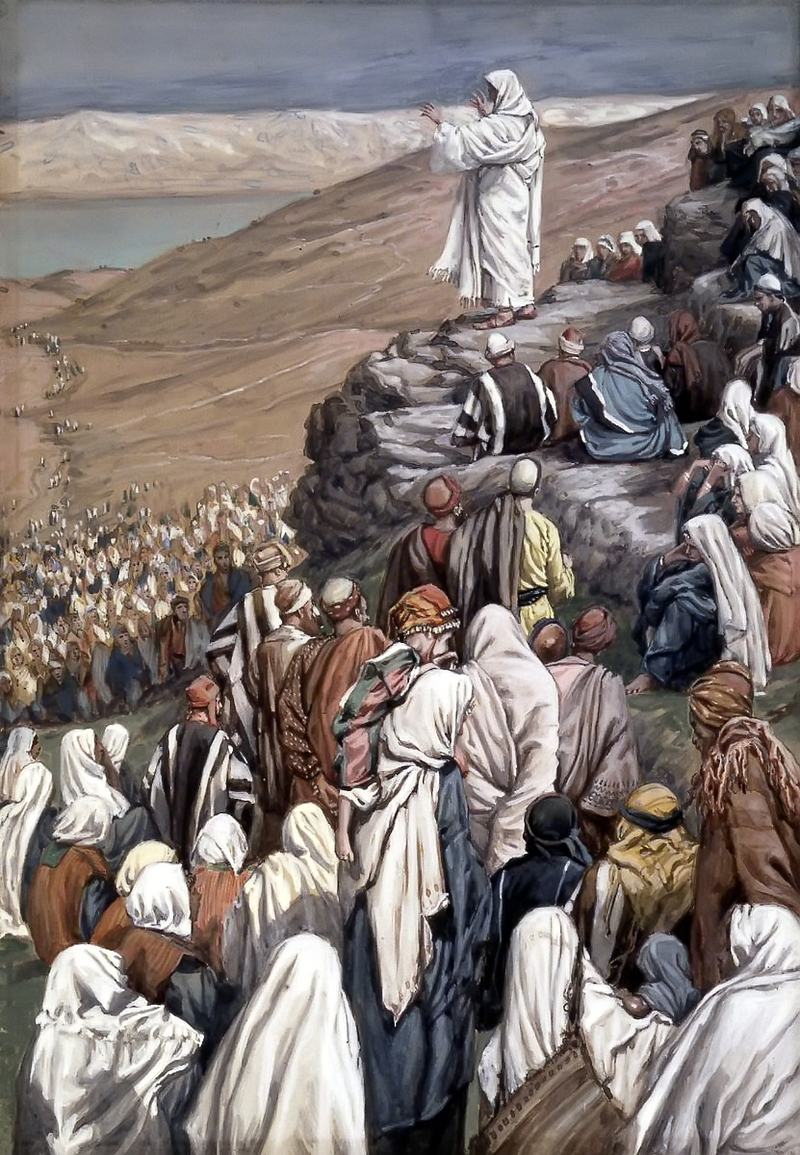
Image: The Beatitudes Sermon by James Tissot, c. 1890
Last week, we saw Jesus begin his public ministry. He preached his first sermon—short, sweet, and to the point: “Repent, for the kingdom of heaven is at hand.” He chose his first four co-workers—Peter and Andrew, James and John. And he embarked on a preaching, teaching, and healing tour of Galilee that drew massive crowds. In a short time, Jesus begins to reveal the kingdom of God, based on something far different than the kingdoms of this world.
Rome, for its part, had a clear outcome in mind. Keeping the peace was good for trade, which was good for collecting taxes. If people wanted to worship their own god or gods, so be it, as long as it didn’t threaten revenue extraction or civic order. If either of these things were threatened, Rome’s bureaucrats had no trouble enforcing peace through violence. Their system of morality was simple: Might makes right. They also had an implicit set of beatitudes, counter to those of Jesus. If we were to construct these, they might look like this:
1. Blessed are the ruthless, for they will inherit the world.
2. Blessed are the wealthy, for they will lack nothing.
3. Blessed are the vengeful, for they will get even.
4. Blessed are the indifferent, for they will never be shaken.
5. Blessed are those who know whose butt to kiss and who should be kissing theirs, for they will move up in the world.
6. Blessed are the manipulators, for they will always have allies.
7. Blessed are the praised and popular, for they have learned the meaning of life.
Undergirding all these is a merciless faith in the inherent morality of the world. Whether people prosper or suffer, the belief goes, they must have deserved it. People are where they are because they deserve it. The beatitudes of empire are basically the prosperity gospel: if you believe hard enough, work hard enough, pray hard enough, give enough, or if you’re allied with the right people, you will receive your just reward. If you don’t, well, sucks to be you. You deserve what you get.
But Jesus’ kingdom is dramatically different. And it lifts up different kinds of people—people who are despised by the world, who are cursed by empire for not bending the knee. And these people, first and foremost, are those who have received the promises of the kingdom of God, rejecting the lies of empire. We know this because the disciples are the primary audience for this sermon. The crowds are there but they are on the margin. They occupy the liminal space between the values of empire and the values of God.
And unfortunately, receiving God’s promises means receiving the cross. Christian faith doesn’t mean everything in this world is fixed for us. It doesn’t make our day-to-day lives easier! It doesn’t help us live our “best life now”! What it does is expose the lies of empire for what they are. It isn’t the wealthiest or most powerful or most popular or most ruthless who are ultimately blessed because they, like everyone else, ultimately die. Even legacies die someday. Nowhere is this better illustrated than the poem “Ozymandias” by Percy Bysshe Shelley. As the poet looks upon a broken-down monument to Pharaoh Ramsses II amid a vast expanse of sand, he spots this inscription:
“My name is Ozymandias, King of Kings:
Look on my works, ye Mighty, and despair!”
The poet continues:
No thing beside remains. Round the decay
Of that colossal wreck, boundless and bare
The lone and level sands stretch far away.
The difference between adherents to empire and adherents to the kingdom is that those who are faithful to God’s kingdom in Jesus Christ have received a promise; a promise which they may perceive no evidence for and yet is truer than anything in this realm. It is the promise of the very kingdom of God.
Receiving and living that promise may mean becoming poor in spirit—cut off from the usual forms of support because the world can’t stand a challenge to its values. It may mean mourning that loss. It may mean feeling utterly incapable of producing change. Kind of like Jesus. When Jesus was arrested and crucified by the power of empire, he was utterly poor in spirit. There was nothing left. He had mourned his upcoming death at Gethsemane, begging his Father God to take the cup of divine wrath from him, without receiving even the dignity of a response. At his arrest, he did not swing a sword. He didn’t incite a riot. He went to the cross. And yet, despite his seeming powerlessness, Jesus exercised the fullest capability of his power on our behalf. Jesus showed God’s deep hunger for justice and righteousness in the world. Jesus showed God’s mercy and righteousness in a situation that was utterly unjust. And Jesus exposed the power of the empire for what it was—the power merely to kill, not to create, redeem, or make holy. The power of empire is simply the power of compulsion. The power of God in Jesus Christ is the power of our complete transformation; as Paul would call it in Romans, the power to give life to the dead and to call into existence the things that do not exist. Such power does not dominate but invites. It does not control but
And at the end of the day, undergirding God’s kingdom is the hidden power of mercy. God’s mercy is shown through Jesus to a merciless world, to a world that wants to do things its own way, that wants to earn its way. This kind of mercy seems foolish to the world. It seemed foolish when the prophet Micah remarked on it seven hundred years before Christ. God, Micah pointed out, did not require grand gestures or magnificent gifts. God required no appeasement or groveling. The main thing remains the main thing: doing justice, loving mercy, and walking humbly with God. Those things are the fruit of faith, just as the beatitudes are. They are not so much prescriptive as descriptive. They are the upside-down values that reveal the kingdom among us, even if we can’t always perceive it.
So, today, receive the fullness of that kingdom here at the communion table. Receive Jesus, who continues to give himself to us in word and water, bread and wine. Even if you don’t perceive him, simply trust the promise. He is here and his kingdom is here, powered by mercy for us all. Amen.
© 2026, David M. Fleener. Permission granted to copy and adapt original material herein for non-commercial purposes.