
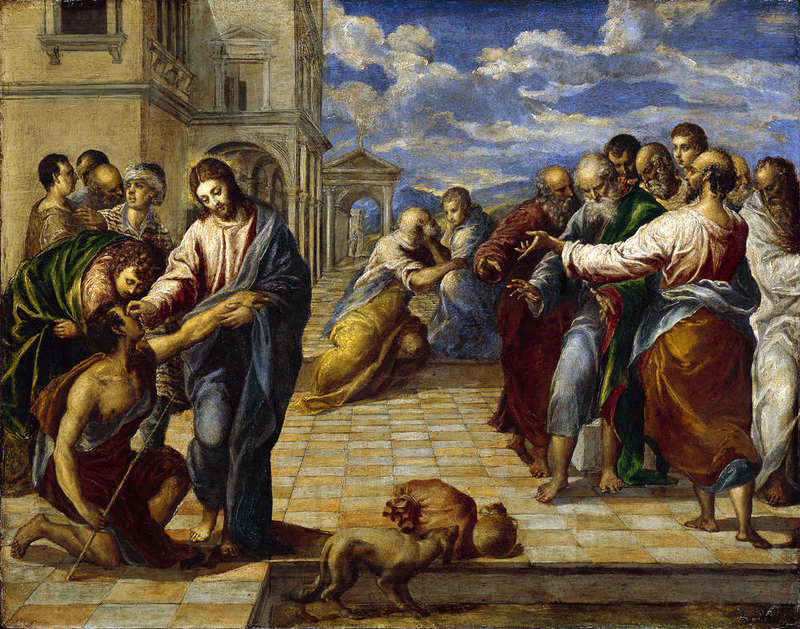
Image: Healing of the Man Born Blind by El Greco, 1567
At a 2007 debate between the atheist philosopher Daniel Dennett and theologian Alister McGrath, an audience member asked whether there was a future for atheism and why. He further stipulated that this answer should not be from a scientific point of view, but from the heart. Dennett’s answer? “Oh, that’s easy. There’s no future for atheism because we’re going to destroy the planet before the future arrives." McGrath’s answer? “I would wickedly say yes, because people don’t know a good thing when they see it.”[1]
People don’t know a good thing when they see it. That is exactly what happens in today’s gospel.
We’re skipping ahead quite a bit in John’s Gospel. But what is happening is in line with what we’ve experienced already. Jesus brings transformation to an individual—and the wider church—through an act of love. But this time, that transformation is put on trial by those who simply can’t recognize a good thing when they see it.
Of course, it isn’t just the blind man in need of healing. The disciples see him and immediately ask: “Who messed up? Who’s to blame for this, Jesus? Did the man do something to deserve this or did his parents?” To be fair to the disciples, there are scriptural passages supporting exactly this interpretation. At the beginning of the Ten Commandments, we hear that God punishes children for the parent’s sins to the third and the fourth generation of those who reject him. Fortunately, there are scriptural correctives to this. Jeremiah 31:19-30 and Ezekiel 18:1-4 tell us that everyone will be responsible for their own sins, not those of their parents. But whether it’s the children suffering for the parent’s sins or people suffering for their own, the point is the same: suffering must have a cause.
Jesus corrects this further—at least in the case of this man. Neither this man nor his parents did anything to deserve blindness and a beggarly existence. This doesn’t mean there aren’t overarching causes of sickness, incapacity, and death that trace back to the fall. But it does mean that in a fallen world, cause and effect don’t go neatly together. This fallen world is not a moral one. It often doesn’t make sense. We only need to open our preferred news app to know that, not to mention notice the suffering around us. But Jesus does something else very interesting. Not only is this man not to blame for his condition, his blindness becomes an occasion for God to do great things in him. This mirrors Paul’s reflection on his own unknown incapacity, which he calls “a thorn in the flesh”. After Paul prayed that it be taken away, God responds, “My grace is sufficient for you, for power is made perfect in weakness,” (2 Cor. 12:9).
Unlike Paul, though, Jesus will not leave this “thorn” in the blind man. He gives him sight. He doesn’t merely restore it. He has never had it. And he does it in the most earthly way possible. Jesus spits on the ground, makes a muddy paste, and puts it on the man’s eyes. (In arid Jerusalem, you can imagine how much saliva Jesus would have to work up to make some mud!) He then gives him a task: Go to the pool of Siloam and wash. We may be put off by the unsanitary nature of Jesus’s methods, but as we learned last week, Jesus is not God safely ensconced in some far-away heaven. Jesus is God embodied, enfleshed, in-the-meat, with all the biological functions and vulnerabilities that implies. And fleshly bodies need physical means of healing, not merely spiritual. Jesus gives this man a sacrament—a one-time sacrament just for him—to receive the amazing, healing power of God’s grace. Such grace is made perfect through the man’s weakness.
But some people just can’t accept a good thing when they see it. His neighbors don’t believe it at first. After all, nothing like that has ever happened before. And when the religious leaders hear of it, they are immediately suspicious. When they learn Jesus is behind the healing, their disbelief hardens into unbelief. Why? First of all, they already have a history with Jesus, going back to his Temple demonstration in John chapter 2. They tried to arrest him in chapter 7 and nearly stoned him at the end of chapter 8. Second, Jesus did not observe proper procedure. He made mud to heal this man on a Sabbath day. Our problem is different today—hardly anyone observes a real Sabbath in our society anymore—but entrapment in procedural minutiae is not different. They try to discount Jesus and the good work he has done for not doing it according to their interpretation of the Commandment. They focus on the minutiae and miss the amazing work that God has been doing.
And don’t we do that sometimes, too? Don’t we sometimes put the absolute worst construction on what our neighbor says and does? (I will grant you, sometimes it can be quite difficult! And sometimes the best construction we can come up with is pretty bad.) Don’t we sometimes miss good things because we magnify all the negatives? Don’t we sometimes dismiss the deed and attack the person? Does that ever happen in your own family? There are plenty of examples around us and, if we’re honest, in our own lives too. It’s a common human failure. And it is caused by a hardened heart toward God and toward each other. The religious leaders are so convinced that Jesus is demonic that they don’t know a good thing when they see it.
So today, recognize a good thing when it is set before you. The Word of God doesn’t always come to us in flashy, exciting ways. It doesn’t come this time from a pastor of a large congregation with a huge children’s and youth programming. It doesn’t come from a congregation with a million-dollar budget. It’s not even coming from a real church service! (I’m preaching today from my office. I don’t even have a ring light on this thing!) It comes from Jesus Christ, who is God dwelling among us, and through people like me and you. The 53rd chapter of Isaiah even says that this Chosen One of God wasn’t much to look at: “He had no form or majesty that we should look at him, nothing in his appearance that we should desire him.” And when Jesus healed the man, he did so in the most unglamorous way we might think of. But the Word was there. And it was there to bring life. It’s here today, too—to bring life to you. Thanks be to God. Amen.
[1] The Future of Atheism: Alister McGrath & Daniel Dennett in Dialogue, ed. Robert B. Stewart, (Minneapolis: Fortress Press, 2008), 45.