
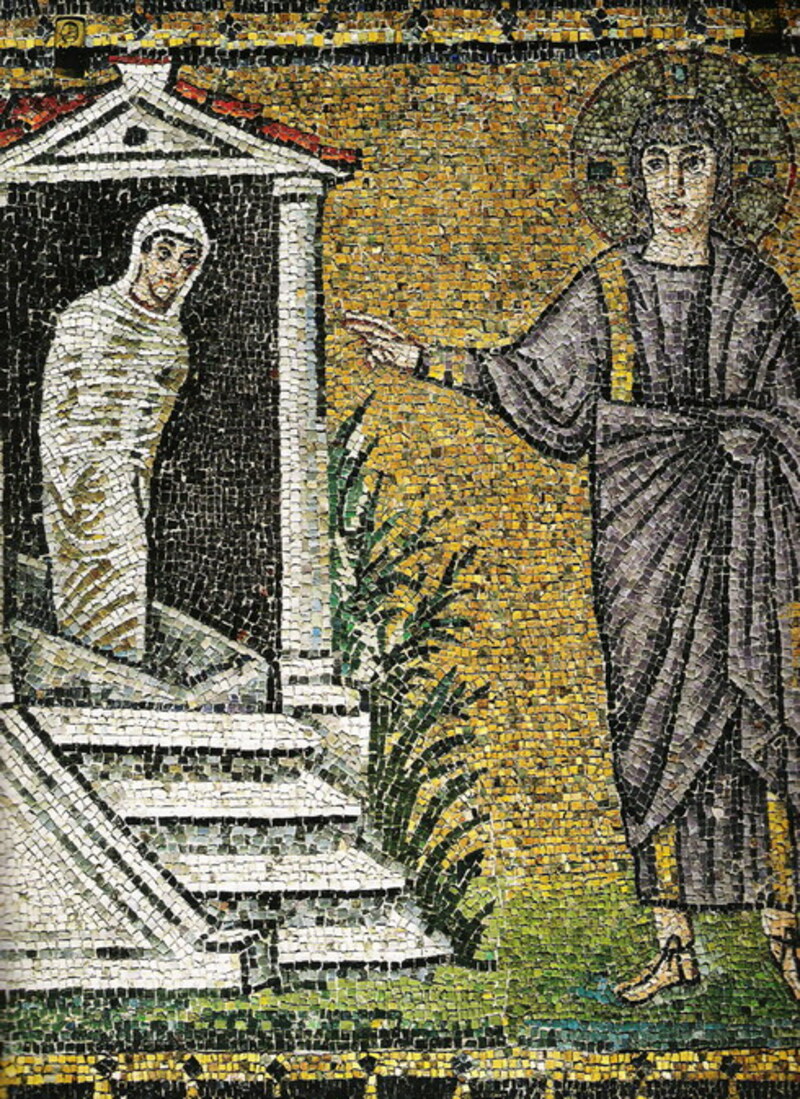
Image: Raising of Lazarus, 6th-century, mosaic, church of Sant'Apollinare Nuovo, Ravenna, Italy
I’d like to begin by asking you a question: At a funeral or a visitation, how are the deceased usually spoken of? Usually well, right? In the nineteen years I have presided at funerals, I have only experienced one where the deceased was spoken of negatively. It just doesn’t happen. The opposite happens. We believe Christians are both sinners and saints, but sometimes the sinner is eulogized right out of a person after they die.
And there’s a good reason. Out of our love for someone, we want to believe there’s something redemptive about their life. We want to believe that their good works counted for something. We want to make the case, at least to ourselves, that someone is worthy of heaven. We want to believe that of ourselves, too. If we were to plot our lives on a behavioral bell graph, with Mother Teresa at one end and Joseph Stalin at the other, we would like to think we at least come out a little better than average, right?
And this desire to be judged well brings us to our gospel reading. We know nearly nothing about Lazarus, but we do know that Jesus loved him. We also know that his sisters, Mary and Martha, cared for Jesus, providing for him out of their means. So, we can guess that Lazarus was what we would call a good man. He and his sisters were generous, kind-hearted people, who supported Jesus and his ministry from the first. If anyone were worthy, Lazarus would be, right?
But Lazarus dies. And what’s more, Jesus deliberately waits two more days after receiving word of his illness. By the time Jesus arrives, he’s been rotting for four days. Little wonder that Mary and Martha are angry with Jesus. “Lord, if you had been here, my brother would not have died.” How often do we say or think something similar in our grief? The psalmist certainly does: “How long, O Lord? Will you forget me forever? How long will you hide your face from me?” They know Jesus and they know what he can do. So, why didn’t he keep it from happening in the first place?
And we get to a crux of the matter. Just as Jesus doesn’t keep Lazarus from going through death, neither does he keep us from going through death. Death comes for all, no matter who we are. It doesn’t matter how much good or evil we’ve done in this life. It doesn’t matter how much money we have. It doesn’t matter what kind of technology we have access to. It doesn’t matter how much we control your diet or our exposure to microplastics. And it doesn’t matter how many sit-ups we do each morning. Death comes to us all as the final word of this sinful world. It is the wage not just of our sin, but of the sin of the whole world.
Which is what makes what Jesus does so extraordinary. Jesus doesn’t just wave his hands and make everything all better. He doesn’t apply a spiritual pharmaceutical to take away the pain. Jesus grieves. The Greek indicates a deep rage against the bitter fruits of this sinful world, of the devastation caused by sin, which expresses itself in an ugly cry. He knows what he will ask his Father to do. He knows his Father will listen to him, just as He always does. But that doesn’t keep him from expressing this grief, especially when he sees what it is doing to Mary, Martha, and all of those with them. Yet again, Jesus is not an “above-the-fray” kind of Messiah. Rather, he descends to our realm to go deeply into the hurting places of our lives, where he grieves with us.
But he doesn’t just do that. Jesus is unafraid to confront the rot emanating from the tomb. He doesn’t do it from afar. He doesn’t stay safely back. He is the Word of God which brings life from death, just as he was spoken over waters at the beginning of creation. That is what is happening here. Jesus is God’s Word speaking a new creation.
And that new creation is a life freed from the law, freed from sin, freed from death. Lazarus is restored to earthly life at this point, but something also radically changes in him. And this radical change is the same that happens in our baptism. When we are baptized, we too are put to death. That’s not something we control. We too are buried. Our sinful selves rot in the grave. Why? Because we know that Jesus is raising us in our baptism every day as a new creation. The Word spoken over the chaos is the Word spoken over us.
This Word isn’t something we can control. We can’t argue our worthiness for it. We can’t list a bunch of accomplishments and say that they counted for anything with God (though they might count with your neighbor). We can’t eulogize our way to receiving it. That saving Word is given out of sheer grace. God gives his saving, life-giving Word because God desires to do so, not because we earned it.
About a decade ago, I was speaking to a prominent lady of the congregation I served who was in her last six months of life. And she was so anxious. She had done her best to live well. And yet, she felt she hadn’t done enough to merit a place with God in the world to come. Think of that! Here was a lifelong Lutheran, raised on the power of grace, who thought she hadn’t done enough. Of course, that’s the whole point. What we do or don’t do can’t save us. We are only saved by God’s amazing grace, received through God-given faith. Nothing else really matters.
And that’s why such grace is so offensive. It’s truly for everyone, bestowed when and where God chooses to do so, without it being based on who we are or what we can do. And that grace also transforms us. We do not and cannot remain as we are. Because when we are touched by God’s grace, we become new people. We are people of God. And the gospel dawns in us. Amen.
© 2026, David M. Fleener. Permission granted to copy and adapt original material herein for non-commercial purposes.