
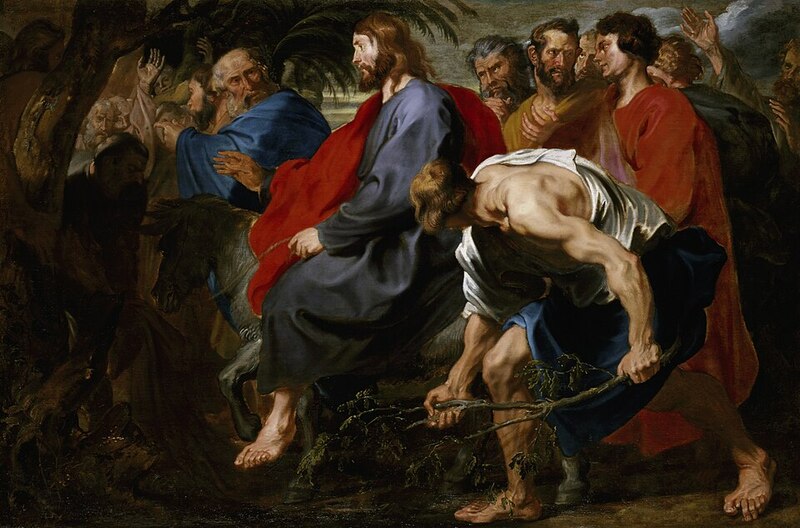
Image: Entry of Christ into Jerusalem, Anthony van Dyck, 1617
When he entered Jerusalem, the whole city was [shaken], asking, “Who is this?” The crowds were saying, “This is the prophet Jesus from Nazareth in Galilee.”
It was an extremely politically fraught time. There were rumblings of discontent among the local population. There were high taxes, an oppressive government, and religious leaders in cahoots with the government. There was a desperate underclass exploited and abused by the powerful. And on top of that, there was a key religious festival coming up that week, which celebrated an ancient liberation from empire. Such festivals made the government nervous. They often fortified the city during that time, in case things got out of hand.
In this tinderbox of a situation, we have a parade. But not a military parade, with handsome warhorses, gleaming helmets, and flashing spears. Rather, a parade of the poor. The dispossessed. The sick and the blind. Children. And the grand marshal? Not a warrior. Not a conqueror, like Xerxes or Alexander or Pompey. Not a politician at all, as it turns out. But a teacher, preacher, and healer from Galilee, a backward province of Rome. Is it any wonder the city asks, “Who is this?”
In the Greek original, the word used to describe the city is seismos. As in seismic. Jesus’s arrival has a seismic impact on the city. As Elvis sang, they’re all shook up. This wasn’t the first time. Long ago, when King Herod learned of King Jesus’ birth, Matthew tells us, “He was frightened and all Jerusalem with him.” The powers that be have dreaded the day of Jesus’ arrival. And it is because they misunderstand both who Jesus is and what he is there to do.
Or maybe not. Jesus does represent the end of their power. The thing is, Jesus won’t do it in the way they expect. After all, every human ruler had used (and still uses) fear as a basis for their authority. Jesus is acclaimed by the title, “son of David”. Does that mean he is going to take the throne back violently? Will he try to re-establish a long-dead dynastic line? Will he exploit Judean hopes of liberation to start an insurrection? And worst of all, will he bring down Rome’s wrath?
Jesus is indeed a liberator, but neither the one expected by the crowds nor dreaded by the Temple authorities. He doesn’t come offering political liberation after the way of the world. After all, most revolutionary movements, even if they succeeded, offered only short-term relief. What usually happened can be summed up in The Who song, “Won’t Get Fooled Again”: “Meet the new boss, same as the old boss.” Whatever the change in leadership, the outcome was usually the same for the people without power.
The liberation Jesus offers is far different and far more than that. His liberation is for the whole person. Jesus liberates us from our sins. It is the reason he is named Jesus, after all. Back in Matthew 1, the angel commands Joseph to name the child Jesus, a variant of the ancient Hebrew name Joshua, because “he will save his people from their sins”. But Jesus doesn’t just liberate us from the things we do wrong. He liberates us from our utter brokenness. He liberates us from unjust religion that exploits, as shown in the Temple marketplace. He liberates us from our captivity to sin. He liberates us from the idolatry of the powers that be. He liberates our creation from futility, as the apostle Paul writes. And ultimately, he liberates us from death, not by killing, but by dying. It is no accident that after Jesus dies, Matthew records a great earthquake and a strange resurrection of “many of the saints that had fallen asleep”. The whole earth is shaken. Death is shaken. And we are shaken. Our sinful selves are put to death with Christ on his cross so that we can rise again, just as those saints did so long ago.
God help remember that whatever the turmoil of the world, we have been liberated from sin and death’s power by the power of Jesus Christ, our gentle king. Amen.
© 2026, David M. Fleener. Permission granted to copy and adapt original material herein for non-commercial purposes.