
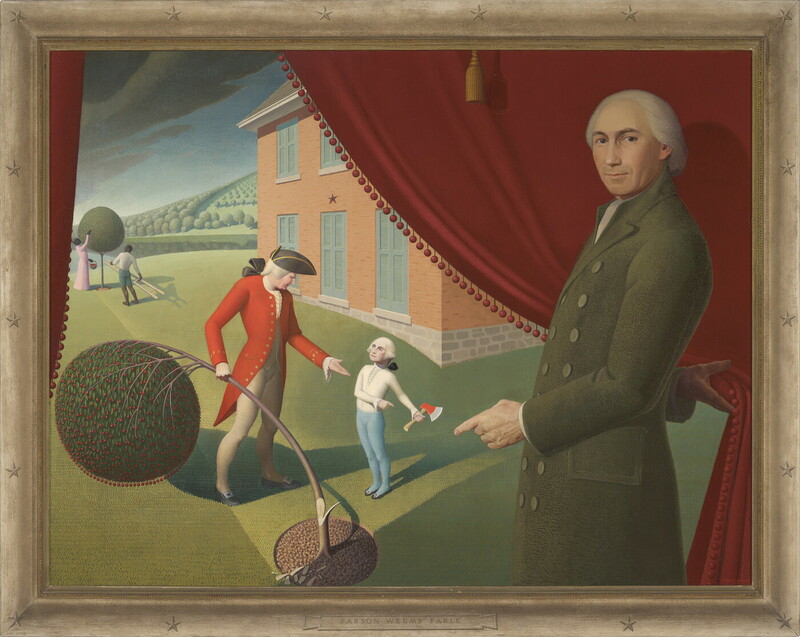
Image: Parson Weems' Fable by Grant Wood, 1939.
The story goes that when George Washington was a lad, he received a hatchet from his father. Now, as boys are wont to do with sharp tools, he started chopping everything in sight! One of the victims of his indiscriminate chopping was his father’s prize cherry tree. When confronted by his father, little George stood up and declared, “I cannot tell a lie! I chopped down the cherry tree!” Moved by his son’s brave honesty, George’s father embraced him instead of punishing him. Such was the immense virtue of America’s greatest founding father, who was first in war, first in peace, and first in the hearts of his countryman.
Or so it would seem. Most of us were told this story in elementary school. How many were told this story as though it were factual? Many of us were. But it turns out this story was a concoction by the American minister and biographer Mason Locke Weems, shown in this painting by Grant Wood on the screen, “drawing back the curtain” on George and his father. Weems was motivated by a deep concern for America’s youth, keen to instill good character in them, even if it meant spinning a few yarns. Which shows a couple things. First, anxiety about youth is perennial. Second, Weems knew that we needed narratives to form cohesion and identity, even if they weren’t accurate.
We need stories. We need them to make sense of ourselves, our communities, and the world. Stories help us process our family upbringing. They help us navigate tragedy and trauma. Through story, we construct an understanding of who we are and our place in the world.
But sometimes, stories are inaccurate and harmful. Conspiracy theories from The Protocols of the Elders of Zion to QAnon have caused massive societal harm. But other, localized tragedies can have convenient narratives, too. For example, there are often ready explanations for, say, Uncle Max’s divorce or Aunt Meg’s alcoholism that let Uncle Max and Aunt Meg off the hook for their actions. There’s always someone or something else to blame. These stories create the fiction, “Everything would be great if it wasn’t for ______.” Case in point. I have a colleague from seminary whose father was a pastor. Apparently, in moments of frustration his dad would sometimes say, “You know, we’re only a few funerals away from a pretty nice parish.”
But it isn’t just these stories that can be harmful. They can also cause harm when they attempt to limit the power of the Word of God to bring faith from unfaith, hope from despair, and life from death. That seems to be the problem for these two disciples.
Now we need to approach this with a lot of grace. These two disciples have had their whole world shattered. In the blink of an eye, Jesus was arrested, tried in a kangaroo court, and killed. He was handed over by one of his closest associates and abandoned by the rest. These two had expected the story to play out differently. And now they were trying to get out of town.
So, with all this on their minds, is it any wonder they couldn’t recognize the stranger in front of them? Everyone knew then, just as everyone knows now that dead people don’t come back. The last person they expected on the road that day was Jesus.
Don’t you love how Jesus plays dumb? “What were you two talking about?” The Greek can be literally translated something like, “What are these words you’re throwing back and forth?”, as if they’re trying to throw some words together to see what makes a coherent story. They stop and look sullen. Darkened. Who is this idiot, they must think. Cleopas snaps, “You’re the only traveler who doesn’t know what’s happened?” Jesus continues to play dumb, “What?” And they tell him the best narrative they’ve got. And there are numerous inaccuracies in their story. There are three main ones. First, they think that Jesus is merely a powerful prophet, while Luke’s Gospel has told us from the beginning that he would be called Son of God, Savior, Messiah, and Lord. Second, they lay blame at the feet of the chief priests and rulers for crucifying Jesus. While accurate, they conveniently leave out their own culpability in abandoning him. And third, their hope was in the restoration of the nation, not in the redemption of the world. In the end, their story ends with an empty tomb but no faith.
So, Jesus corrects their narrative to give them a better story. How does he start? Well, he calls them “thick-headed” and “slow-hearted”. He’s angry. Why couldn’t they get it? He’s been telling them this from the beginning. But then, he patiently gives them an interpretation. He translates the Scriptures for them so they no longer see everything through unfaith but through faith. Beginning with the Torah—the books of Moses—and continuing through the prophets, Jesus opens their minds and hearts to understand. He is patient with them. He stays with them to share a meal. And only when they share that meal are their eyes opened. Only then do they see Jesus. He utterly overturns their faulty narrative so that they can have a life-giving one. Where they thought Jesus was a mere prophet who got on the wrong side of the law, Jesus revealed himself as the Author of Life who forgives all sin, even the sin of those who crucified him. Even while they were looking for someone to blame, Jesus shows them not just their own culpability, but also the fact that God integrated that sin into the redemption of the cosmos. As Paul wrote in Romans, “He has imprisoned all in disobedience so that he may be merciful to all.” And where they think salvation is confined to one group of people, Jesus shows them that redemption is offered to all.
And that’s what Jesus does for us today. Jesus gives us a better story, one that is not dependent on our own ability to construct a narrative. You can’t construct your way to the resurrection, after all. Just as he did for the disciples, Jesus patiently interprets the Scriptures for us so that we see his presence on every page. Just as he did for them, Jesus patiently stays with us in community, particularly when we share Holy Communion. And in doing that, Jesus empowers us to let go of all inaccurate and harmful narratives that keep us in chains. We let go of everything that chains us to blame, to pride and arrogance, to scapegoating. All those stories have an end. But the story of the cross and resurrection of Jesus Christ endure forever. It endures because we know that Jesus abides with us forever. And that his presence doesn’t depend on us. He shows up, just as he showed up in the breaking of the bread and as he shows up to all the disciples in that room at the end of the gospel. And his words to us are the same as the words to them: Peace be with you.
© 2026, David M. Fleener. Permission granted to copy and adapt original material herein for non-commercial purposes.