
|
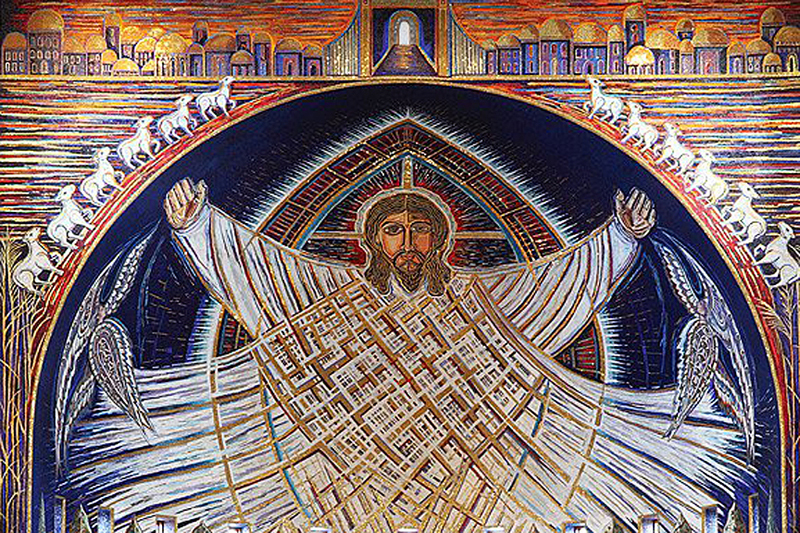
Image: Helen McLean, Christ in Glory, from Art in the Christian Tradition, a project of the Vanderbilt Divinity Library, Nashville, TN. https://diglib.library.vanderbilt.edu/act-imagelink.pl?RC=56321 |
Over 16 years of pastoring, I’ve facilitated premarital counseling for about 25 couples. And one of the most important things we talk about is the family they grew up in because it has a dramatic impact on how the couple will function in their new family.
Every family is different. Some families make a big deal out of birthdays or holidays. Others don’t. Some families are very close-knit, doing many things together. Others have greater individual autonomy. Some families have “their thing” they center around, whether athletics or church or music. Others are decentralized, with many different “things”. Some families struggle with addiction. Others struggle with unhealthy behaviors that aren’t driven by chemical use. Some have families where the parents have remained married, while others come from blended families. Every single family is different. And every single family’s strength has a shadow side. For example, families with a high level of connection can feel suffocating to some members, while more autonomous families can feel disconnected. No family is perfect. And whenever couples begin a new family, they will carry both healthy and unhealthy behaviors with them.
Those behaviors carry into the church as well. We use family language a lot. The church is described as a big family, after all, with God as our Father and Jesus as our brother. But church families don’t always act in a healthy manner. Anyone who’s belonged to the church for more than a month knows that. You especially know that if you’ve been in a leadership role. Church families, like all families, have the capacity for unhealthy behaviors. Often, those behaviors are driven by anxiety, fear, or mistrust. Just because we have been adopted into the Lord’s family through baptism doesn’t mean that we don’t have to contend against the old sinful creature in us our whole lives. Belonging to Jesus is not a magic cure-all. Our hearts, like those of the disciples, are often anxious and fearful.
And the disciples are in that anxious, fearful, troubled place at the beginning of our gospel reading. They know that Jesus is going away. But they can’t receive that news as anything but bad. They may think that Jesus is abandoning them. No fear is more primal than abandonment. After all, that is one of the primary reasons we might fear death. In an interview, Mr. Rogers said, “…what are we scared of, as far as death's concerned? We're scared that there won't be anybody there to feed us, or to take care of us.” For these disciples, abandonment might as well be death, not just of their spiritual family, but of themselves too. They are so captured by their fear and grief that they can’t trust Jesus. They can’t trust that Jesus is going away so he can return to them in his resurrection and in the Holy Spirit.
So, these are who Jesus is preaching to—friends whose fear and grief has made them imperceptive to the gospel. Their hearts are churning seas, with chaotic waves of fear and grief. But into this chaotic storm comes this command: “Do not let your hearts be disturbed. Have faith in God, that is, have faith in me.” The clarion call to faith in Jesus sounds. And then Jesus gives them this amazing promise: “In my Father’s household—in my Father’s family—there is plenty of room.” There is room! There is space! This is not so much a description of a place as it is a description of space. There is space for all in God’s family, despite the chaos of the world. There is space for you, for me, and for all, even and especially for those who do not have a space anywhere else.
About 15 years ago, my home congregation, Bethany Lutheran Church of Elkader, Iowa, adopted a statement of welcome. While it is a little dated, I think it’s worth reading the whole thing.
We want it to be of public record that those of all racial and ethnic groups are welcome here.
We want it to be of public record that people of all sexual orientations and members of their families are welcome here.
We want it to be known that those who suffer from addiction to drugs and alcohol (whether recovering or not), and their families are welcome here.
We want it to be known that women & men, girls & boys are welcome here and that they will not be harassed or abused here.
We want it to be of public record that in this congregation you can bring children to worship and even if they cry during the entire service, they are welcome.
We want it to be known that those who are promiscuous, or have had an abortion, or have fathered children and taken no responsibility for them, are welcome here.
We want it to be known that gossips, cheats, liars, thieves, and their families are welcome here.
We want it to be known that those who are disobedient to their parents and who have family problems are welcome here.
Let it be public knowledge that we at Bethany Lutheran Church take seriously that all have sinned and fall short of the glory of God. The young and old, the rich and poor, all of the broken are welcome here.
We want it to be public knowledge that we are justified by the grace of God and given the gift of redemption through Christ Jesus our Lord.
We offer welcome here because we believe that while we were yet sinners Christ died for the ungodly. That’s us. Christ did not die for us after we showed signs of “getting it all together.” Christ loved and still shows love to us while we are yet sinners
Sinners are welcome here, sinners like you and me, and like our neighbors. Let us not condemn the world, but let us proclaim to a broken and hurting world, God’s forgiveness and grace.
We want it to be of public record that since we are a sinful people, we will not always be as quick to welcome as we should. Let us be quick to admit our sin and seek forgiveness.
May God give us the grace to welcome and forgive one another as Christ has welcomed and forgiven us.
Do some of those kinds of people offend you? I hope so! The grace of the gospel is both radical and offensive—radical in the scope and offensive in the kinds of people it reaches out to. Everyone has a place in God’s family, especially those who have no place anywhere else. And maybe today you wonder if there’s a place for you in the family of God. There is, and Jesus has made it so. He went to the cross for you and me so we could have a place in his family forever. That is true no matter what kind of family we ourselves come from. Jesus has made us his own forever.
So don’t be troubled, anxious, or fearful, no matter the turmoil in our own lives or the turmoil in the world. Don’t be troubled, anxious, or fearful, no matter the storms that rage in our own hearts. Jesus has welcomed you. From the moment of your baptism (and perhaps even before), Jesus welcomed you. (I know for a fact that even before I was baptized, Jesus extended his wide welcome to me.) There is indeed a place for you. Amen.
© 2026, David M. Fleener. Permission granted to copy and adapt original material herein for non-commercial purposes.