
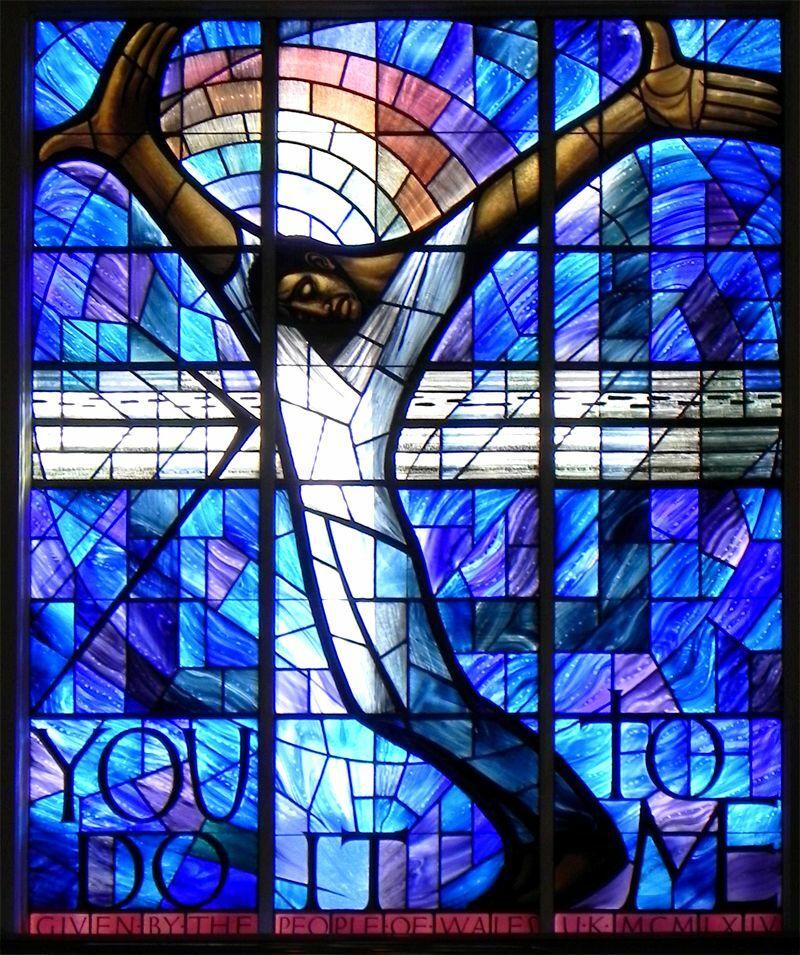
Image: John Petts, 1914-1991. Christ Crucified, from Art in the Christian Tradition, a project of the Vanderbilt University Divinity Library, Nashville, TN. https://act.library.vanderbilt.edu/artworks/57342 [retrieved September 13, 2026].
Over the past few months, I’ve preached on forgiveness quite a bit. Not only has it come up repeatedly in the texts, but it’s also something we all struggle with. Part of the reason for this is that we’ve been brainwashed into wrong ideas about what forgiveness is. Another reason is that we tend to hold onto wrongs done to us, past the point where it would be healthy for us to release them. And yet another reason is that we so often see ourselves as the ones in the right, giving forgiveness rather than in need of it.
Thank God for Peter because in him we have a mirror of ourselves. Peter, like most of us, wants to see himself as a good and gracious person. From the beginning of chapter 18, Jesus has shown them what greatness looks like in the kingdom of heaven; it looks like vulnerability, exemplified in a little child. He has warned them against scandalizing such vulnerable ones, saying, “It would be better if a large stone were tied around your neck and you were thrown into the sea.” He has also talked about dealing with sin in the church, giving specific instructions for doing so: it must be first done one-to-one, then with a couple witnesses if necessary, then with the whole church. The intent is not to humiliate the person, but to help them see how they have broken with the wider community and be restored to it. If they will not, Jesus says, “Treat them like a gentile or tax collector.” In other words, start over just as Jesus himself started at the very beginning with gentiles and tax collectors.
But Peter, like us most of the time, doesn’t see himself as the one in need of forgiveness. He wrongly thinks that he will be giving forgiveness more than receiving it. And that presumption is everywhere. Such a question like Peter’s smacks of virtue-signaling. Look how forbearing and gentle I am, willing to forgive up to seven times! But Jesus has another answer for him; one he probably didn’t expect. Not seven, but seventy-seven times. In other words, just as God’s forgiveness of us is without limit, ours should be also.
But…as I mentioned before, we are often brainwashed by a false definition of forgiveness. There are several distortions of forgiveness. Four come to mind.
The first is minimizing what happened. Too many vulnerable people have been told by powerful people, in church and society, to overlook the offense altogether, calling that forgiveness. The sex abuse crisis in the church over the past 30 years shows how this attitude perpetuates great harm. The divorce of forgiveness from accountability has been nothing short of a disaster.
The second is the belief that forgiveness ought to be instantaneous; that the moment I say I forgive you, it’s all forgiven. Hopefully that’s true with small stuff, but big stuff usually takes a lot longer, a lot more energy, and a lot more intention. For God, certainly, forgiveness is instantaneous, but with us it often isn’t.
The third is the insistence on linking forgiveness with reconciliation. The classic example is the demand for a battered spouse to get back together with his or her abuser. As much as reconciliation may be worth working for, for reasons of health, it is simply not possible sometimes. And insisting on it as part of forgiveness can do further violence.
The last is Peter’s pitfall: the belief that we’re wholly innocent. Now I’m not talking about cases of outright abuse. But that’s not what most of us deal with most of the time. You see perpetual victimhood everywhere, often for the most miniscule offenses. Our endless, exhausting politics can be summed up like this: different groups of people believe that they’re pure and righteous and have been done unto by “those people”, therefore they can do what they like to even the score. There’s little listening and even less understanding. Forgiveness under such conditions becomes impossible.
So, what is forgiveness then? Forgiveness is letting go of our desire for revenge. Simple as that. It doesn’t minimize what happened. It doesn’t entertain any illusions about how difficult it might be. It means relinquishing them, ultimately, to God. In some cases, the justice system may need to do its work. In others, we may need to do some significant trauma work. But forgiveness is the affirmation that the other person, ultimately, belongs to God and not to us.
Little wonder Jesus told the parable he did, if nothing else than to shake the disciples from the delusion of self-righteousness. The parable is hard. We may wonder what kind of lord would take back forgiveness after granting it. But that’s probably not the point. The point is that we all belong to and are ultimately answerable to God for what we do. And God in Christ forgives us time and time again, restoring us to relationship with him. God’s forgiveness is so great that in Christ, he threw out the sin-accounting book altogether. In Jesus Christ, we are new people, washed in water, gifted the word, and fed his body so we can be his body in the world. Jesus destroys all distortions of forgiveness and gives us the power to forgive others, in whatever time or space that takes place, even if it is less than ideal.
And we see such empowerment in the case of Joseph. Joseph was made utterly powerless by his brothers early in the story. They stripped the fancy coat their dad made for him, threw him into a pit, and sold him into slavery. But God raised him up to a position of great power in Egypt. Out of that power, Joseph could have done whatever he wanted to his brothers. He could have sold them into slavery or thrown them in prison to rot. But he doesn’t get revenge. And while the brothers have turned over a new leaf to some extent—after all, Judah sticks up for Benjamin in the case of the missing silver cup—they haven’t completely changed. The brothers are frightened after their father Jacob dies and think that Joseph will get revenge, so they seem to invent instructions that Jacob never gave (or at least never explicitly gave), that Joseph ought to forgive them. It’s all about self-preservation. But Joseph doesn’t care about their motivation. He simply reminds them that he is not in the place of God. Vengeance is not his job. What he does instead, out of the renewed agency he has, is reunite and heal a fractured family—the very family that God will use to proclaim the good news to the whole world.
Our own cases may be different. We may not be lords of Egypt as Joseph was. But the fact remains that out of our baptism, we have been empowered to forgive as God forgives us. We’re children of the king. We’re free to let go of grudges, hate, fear, revulsion. We’re free to live differently. And we’re freed to be God’s shalom people in the world. That is real empowerment. That is real life. Amen.
© 2026, David M. Fleener. Permission granted to copy and adapt original material herein for non-commercial purposes.