
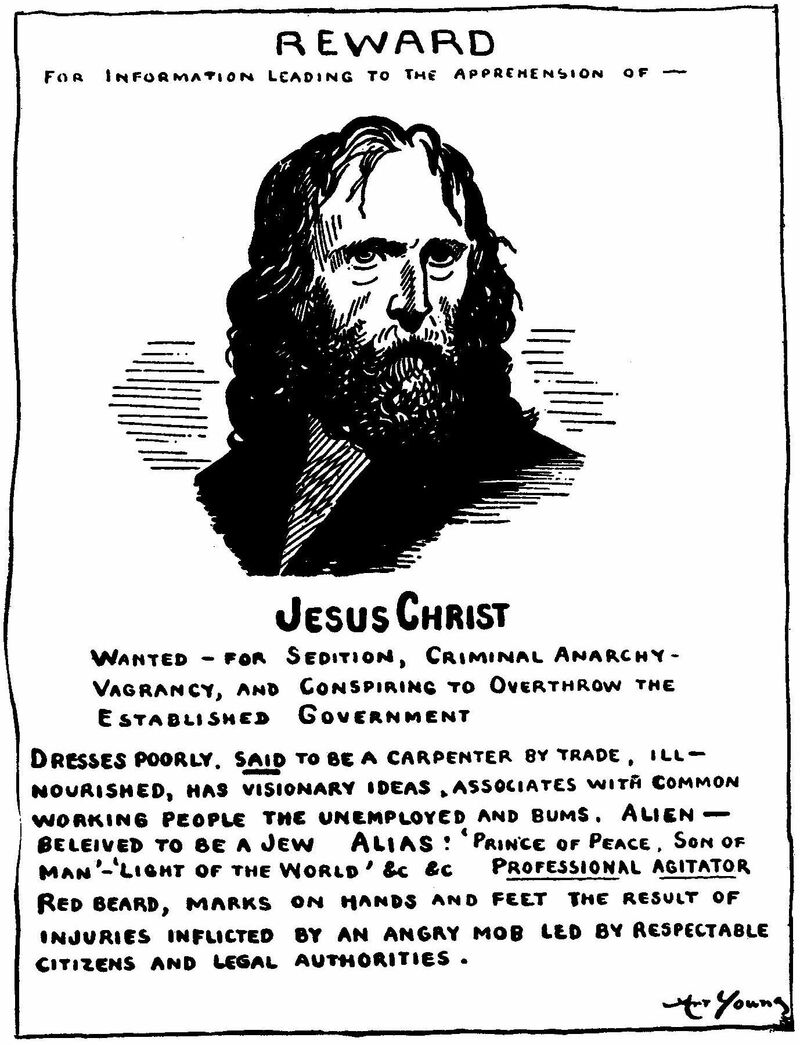
Image: Art Young, Jesus Wanted poster. http://diglib.library.vanderbilt.edu/act-imagelink.pl?RC=59079.
This is the second week of our generosity campaign, “Empowered by God; Responding by Grace.” Today’s reading invites us to consider the nature of power and authority. What does it mean to be empowered? What is godly power? And how do we misunderstand it?
By the time Jesus teaches in the Temple precincts, he has already set in motion the events that will lead to his crucifixion outside Jerusalem. He entered the city as the gentle and humble king foretold in the book of Zechariah, then went into the Temple and acted with striking force. He drove out the money changers and those buying and selling, challenging the very idea of a Temple marketplace. Such a powerful act naturally provoked resistance. The chief priests and scribes depended on that marketplace—and on Roman power to preserve their positions. Nothing made them more anxious than the prospect of a crackdown after a public disturbance in the Temple.
When they confront Jesus, they have three aims: discredit him as a garden-variety religious nut, trap him into saying something that will prompt the Romans to arrest him as a threat to public order, and—most importantly—protect their own power and position. One question might accomplish all three: “By what authority are you doing these things?” If Jesus answers, “From God,” they have what they need.
In other words: “What right do you have to act here, Jesus? Who gave you this authority?” Yet their trap exposes how thoroughly they misunderstand divine power.
They appear to see Jesus as merely a social activist, a politician, a critic of the Temple, or another zealot taking matters into his own hands. But Jesus is none of these. They do not—perhaps cannot—recognize who he is or understand the nature of his power. Jesus exposes their hollow question by posing one of his own. He escapes their trap and, through the parable, indicts them for misusing power: they claim faithfulness while acting unfaithfully.
Jesus’ power is radically different than they—and we—often imagine. In his letter to the Philippians, the apostle Paul elaborates:
Adopt the same mind that was in Christ Jesus:
though he existed in the form of God,
he did not treat equality with God
as something to be seized,
but emptied himself,
taking the form of a slave
and becoming human.
Found in human likeness,
he humbled himself
and obeyed even to death—
death on a cross.
Therefore God exalted him still higher
and gave him the name
above every name,
so that at the name of Jesus
every knee should bend—
in heaven, on earth, and under the earth—
and every tongue confess
that Jesus Christ is Lord,
to the glory of God the Father.
Jesus’ power does not follow the world’s pattern. The world often treats power as something to seize and exploit, and many leaders use it for themselves rather than stewarding it for others. Jesus, by contrast, shows the power of letting go. His greatest act of power was to surrender the trappings of power and glory. He came among us not as a bloodthirsty, triumphant monarch imposing his will, but as the herald of God’s kingdom of perfect justice and love—healing its people and forgiving their sins. That message could not coexist with the top-down, exploitative rule of the priestly hierarchy and its Roman overlords. So, Jesus was executed as a common rebel on a Roman cross, made into a humiliating example for all to see. You want to see your king, O Israel? There he is—on a Roman cross. So much for divine power, it would seem. The only power perceptible to the human eye was the power of empire wielding the weapon of death.
Yet Jesus accepted this willingly. He obeyed to the point of death—even death on a cross—and God raised him up, giving him the name above every name. As Christians, we bow only to our gentle king, Jesus, whose power is expressed not in condemnation but in mercy. We do not surrender our consciences to any civic, corporate, or religious leader. The powers of this world may rule our bodies, but, as Luther wrote in his commentary on Galatians, they go too far when they claim authority over our consciences. We belong ultimately to Jesus. In the end, the knee bows not to Caesar, but to Christ.
Those who belong to Jesus receive his distinctive power. It is not the power to dominate or control, but the power to forgive sins and bring healing and wholeness to a hurting, weary world. Some of us do exercise authority on behalf of the state; even I do so when I officiate a wedding. But such authority is not the source of forgiveness and healing. No power that originates in this world can forgive a single sin or restore us in the image of Christ. Rather, the source of such healing and forgiveness is the same as the source of John’s baptism, the Old Testament prophets—many of whom were persecuted and killed—and Jesus himself. The source of such power is God—our loving Father and the Father of our Lord Jesus Christ. The power is poured out on us in baptism, when we are washed and sealed in the Triune Name; renewed as we hear the Word and receive holy communion; and exercised in daily life. And there are many places we are called to use such divine power. For example, we may use it by giving time or resources to proclaim the Word. We might support ministries of care such as the Food Shelf or Love INC. We might call or visit those who are lonely or grieving—especially needed now when our congregation has so many who are sick and suffering. We can especially call upon that power in releasing grudges and in prayer. If you can do nothing else, pray. If prayer feels beyond you, say the Lord’s Prayer for yourself and our world. And if even that is too much, simply say, “Help!”
Divine power is not control and domination after the way of empire, but merciful love practiced in obedience for our sake. God help us exercise that same power wherever we are called to do so. Amen.
© 2026, David M. Fleener. Permission granted to copy and adapt original material herein for non-commercial purposes.