
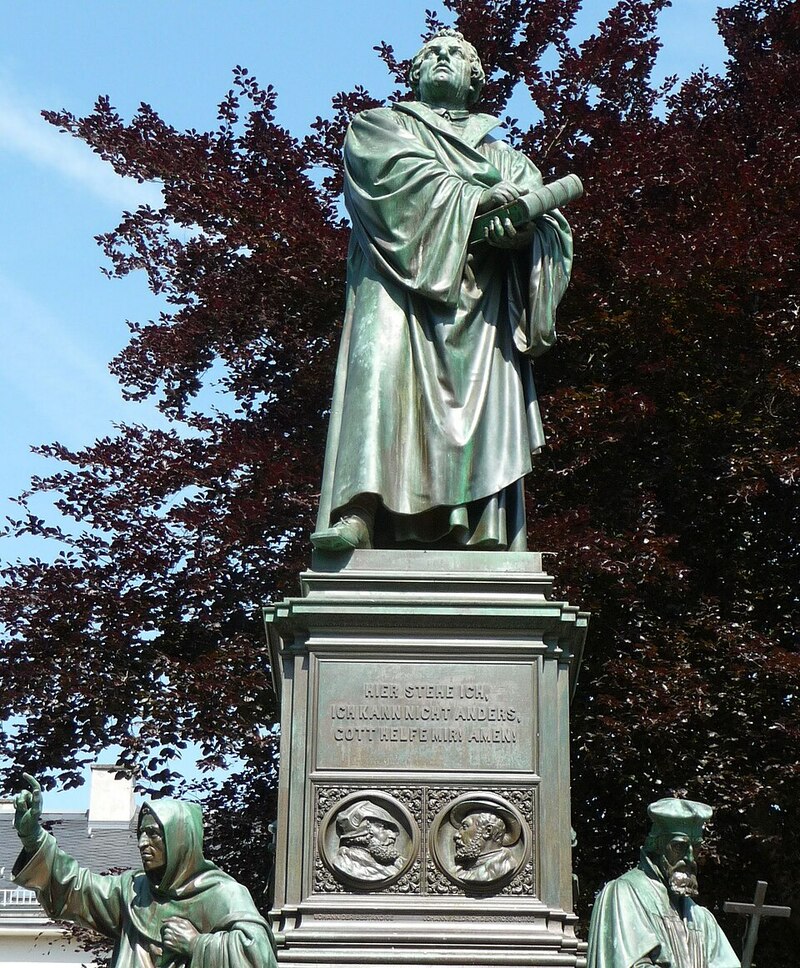
Image: Statue of Luther from the Luther Monument in Worms, Germany.
I know I’m a strange person, but I have a soft spot for Leviticus, as well as for the rest of the Old Testament. Some of you may remember that five years ago, I even preached a five-week series on Leviticus! (However, I think I tried your patience a bit with that series. A few days after I preached the third sermon in that series, one of you came up to me at the grocery store and said, “I’m getting tired of Leviticus!”)
I get it. Leviticus has a reputation among Christians for being a dry book of boring old rules that have no consequence for us today. After all, not many of us are concerned with the proper procedures for whole-burnt offerings or grain offerings. Not too many of us are concerned about ritual uncleanliness brought about by exposure to certain bodily fluids. Not too many of us abstain from pork or shellfish.
But Leviticus at its core has one particular concern which makes it relevant to today’s church. There are other concerns too, but there is one main thing. God’s people are to be holy. They are to be set apart from other peoples as a “light to the nations”, as Isaiah 42:6 and 49:6 both declare. Why? Because God himself is holy, completely set apart from his creation. God is utterly unknowable and unperceivable unless and until God chooses to reveal himself. This setting apart is salvific. Because God chose a people to set apart to be the means through which the salvation of the cosmos would be accomplished, God expects a certain standard of behavior from those people. The same could be said for Christians today. Because knowledge of Christ usually comes through the church, God expects a particular standard of behavior from us, too. God expects the people to act in a merciful way toward people who are poor or the foreigners living with them—not gleaning your field completely was the social safety net in those days. God expects the people to give wages in a timely manner, to be honest in business dealings, to speak honestly about their neighbors, and refrain hold a grudge. In short, God expects his people to love their neighbors as themselves. Those behaviors mirror the God who loves them.
Yet, God’s people, both ancient and modern, have repeatedly proven themselves to be less than holy. The whole of the Old Testament (and much of the New, for that matter) is a story of failure. God gives the people his commandments, which are rules for living a free life, whether that freedom is from Pharaoh or from one’s own destructive desires. And repeatedly, God’s people fail to live into that free life. The period of judges (after Joshua but before David) went so poorly because as the Book of Judges says, “everyone did what was right in his own eyes.” The people, desiring a quick fix, demand a king to rule over them like the other nations, which seems to go well for a while, but then descends into chaos and destruction. God sends prophets to bring the people back to the path of freedom, but they repeatedly choose their own enslavement, whether to idols, leaders, or the comforts of wealth.
And we’re not different today. We have our own idols we’re captive to, whether it is ideology, wealth, control, or something else. We’re not going to get our act together. We’re not going to live fully as God’s beloved community in this world. We’re not going to be holy as God is holy, not by our own power or strength. No matter how many sermons are preached, no matter how many self-help books are released, no matter how many new and clever forms of mental health therapy are developed, there is nothing we can do to kill the old sinner within ourselves.
That was Martin Luther’s struggle. In an age where death was everywhere and fear of damnation was in the air, Luther discovered that he could never be good enough for God. No matter how many times he confessed his sins, no matter how many psalms he prayed or penances he endured, nothing he did could shake him from the feeling of being utterly lost and condemned.
Now, granted, Luther was scrupulous. He felt the imminent wrath and judgment of God much more intensely than most of us ever do, to the point that psychologists and analysts have had a field day with him. But that doesn’t change his key insight: Nothing we do can make us right with God. God’s grace, given in love, received through faith, makes us right with God. We are holy not because of what we do. We are holy because of who God has made us to be in our baptism. Luther learned that the Father revealed in Jesus Christ through their Spirit is a God of mercy, who gives us his holiness freely.
And this holiness is given to us out of nothing but love. God’s love moved the Spirit over the waters of chaos to create the cosmos in the first place. God’s love created humanity in God’s image. God’s love chose Abraham and his family as the means of blessing to a world broken by sin. God’s love gave the law, including the commandment to love God and our neighbors. God’s love sent prophets to call the people back to the way of freedom. God’s love sustained the people in exile in Babylon and brought them back with a strengthened sense of both who they were and whose they were. God’s love sustained the people throughout foreign domination and oppression. And God the Father, out of love, sent his Son Jesus for our sake, to live among us, to teach, to heal, to proclaim the kingdom of his Father, and to suffer, die, and rise again so that we might have a place with him forever. Luther had another insight in this regard, borrowing from the fourth century church father Athanasius, who himself borrowed it from St. Paul in 2 Corinthians 5:10: Jesus Christ takes on everything that we are so that we can take on everything that he is. Jesus Christ takes on our sin, our suffering, our shame, our failure, our hatred, our fear, our despair, our pride so that we can take on his sonship (or to be more inclusive, his “childship” with the Father), his light, his victory, his love, his faith, his grace, his holiness, and his full humanity. Through him, we participate in God’s life, in God’s nature, in God’s fullness, in God’s shalom.
We live in a world that often seems as far from holiness as it can get. The news can cause us to despair of God’s love and mercy. But we know that because of Jesus Christ, the love of God for us, that there is a destination for us and for all creation that doesn’t end in death. Julian of Norwich, a 14th-century English mystic, put it like this: “All shall be well, and all shall be well, and all manner of things shall be well…. For there is a Force of Love moving through the universe that holds us fast and will never let us go.”
God renew our faith in that one thing—God’s eternal, unwavering love for us. Amen.
© 2026, David M. Fleener. Permission granted to copy and adapt original material herein for non-commercial purposes.