
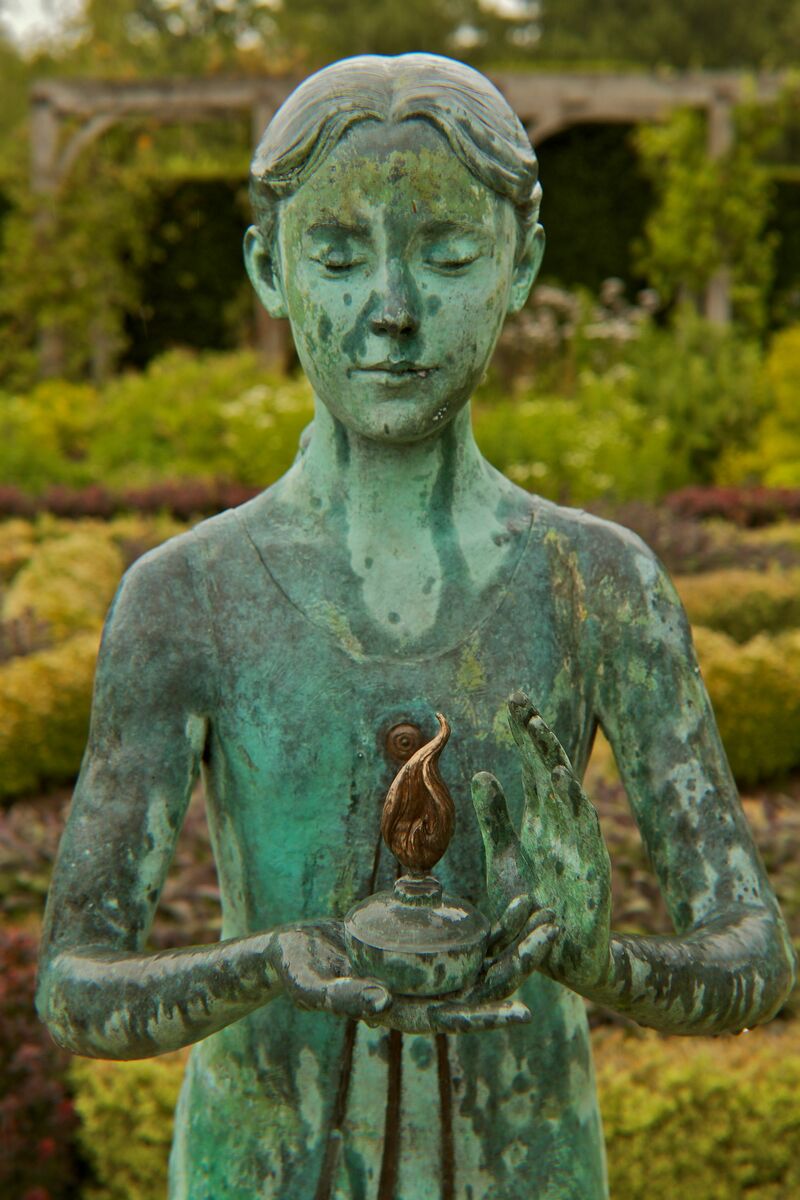
Image: Lamp of Wisdom, from Art in the Christian Tradition, a project of the Vanderbilt University Divinity Library, Nashville, TN. https://act.library.vanderbilt.edu/artworks/54977 [retrieved November 8, 2026].
This Sunday after Election Day, I’m going to reiterate what I said to you all two years ago. Some of you may be hopeful or excited after Tuesday’s results. And some of you may be anxious, disappointed, or angry. Some of you may think our country is moving in the right direction and some of you may think we’re moving far away from it.
Whatever headspace you’re in this morning, one thing remains the same. We have an identity greater than Republican or Democrat, greater than who we voted for, greater even than our common national identity. Our chief identity is in Jesus Christ, who has formed us into his body, the church—and Jesus’ body is always one. And this is what makes the church different from a political party, a school, a service club, a state, or a nation: We have an unshakeable promise from God. Whatever happens to us in this world, we are not abandoned to death but will be raised up to a life beyond our imagination. There is no need to be anxious about anything in this world because God remembers us both in this one and in the one to come.
And yet, we get anxious, despite Jesus’ clear instructions to not be anxious! We get anxious about so many things: our families, our finances, our time, our health. Yet, the anxiety at Thessalonica is the ancient anxiety of human beings, an anxiety that many of us carry: anxiety about death. Such anxiety was present at Thessalonica when Paul wrote this letter. A little background: 1 Thessalonians may be the earliest written document in the New Testament, with a possible date of 50-51. That’s about 20 years, give or take, since Jesus walked out of the tomb that Easter morning. Now, we need to remember a few things. First, most early Christians believed that Jesus would return in their lifetime. Paul was likely among them. After all, Jesus did say, “There are some standing here who will not taste death before the Son of Man comes in his glory.” Second, some members of the church had died. If they died before Jesus had returned, was there hope for them? And third, the church was regarded, at best, with deep suspicion from the dominant culture. Christians did not participate in the civic religious cults, which offered sacrifice and prayers to the gods of the city and empire for their well-being. And their links to the long-established Jewish synagogue was increasingly being frayed. Read Acts 17 for more detail.
In that stew of anxiety, Paul writes of hope. But not a fleeting hope in something vague like a better tomorrow or a gentler regime. Paul speaks of ultimate hope, a hope renewed not by earthly circumstances but by divine promise. In an early echo of Romans 8, Paul reminds these anxious, fearful Thessalonians that death cannot separate them from Jesus. And even though all the living are eventually forgotten in this realm, God never forgets his faithful ones. God never abandons them. Rather, Paul says that the living have no precedence over the dead. The dead will rise and they, along with the living will go up to meet the Lord Jesus as he returns. By the way, this is not the false teaching of rapture, which envisions millions of people disappearing into thin air, as in the Left Behind series. This is God’s faithful people greeting their king as he returns to establish his throne forever. Notice the movement here. We don’t stay “up” with Jesus; we accompany him as he comes down to us, just as the faithful accompanied Jesus on his triumphant entry into Jerusalem. The direction is always toward Jesus and toward the creation which God loves and will make new. God is faithful and God keeps promises.
And yet, the sin of unfaith can easily lurk within us, as it lurked within the five foolish women of the parable. Now…I don’t like this parable. Which means it’s a good parable! It does what a parable is supposed to do, which is mess with our understanding of God’s reign among us. There are so many attempts out there to allegorize this parable, where the young women are the church, the bridegroom is Jesus, the oil is faith, hope, or love, which apparently can’t be shared, the party in the house is heaven and the darkness outside is hell. Some of those certainly could have applied. But let go of that for a moment. Maybe, a more helpful way to look at this parable would be to look at the movement.
The biggest mistake the five foolish ones may have made may not have been their lack of preparation. After all, both wise and foolish “fell asleep”. They didn’t “keep watch”, which is supposed to be the point at the end of the parable. Their biggest mistake may have been moving away from the bridegroom rather than toward him, oil or no oil. This does raise disturbing questions about the conduct of the “wise” ones, but this parable, like all of them, doesn’t map onto anything that makes a worldly kind of sense. We’re talking about a vision of the reign of God. And in this vision, five women move toward the groom when the cry announces his arrival, and five move away to address a self-perceived lack.
We can tie so many extra burdens on ourselves sometimes, can’t we? Like the women, we can think that we don’t have enough or that we’re not enough to come before our Lord. We can get anxious about ourselves and get stuck on our lack. It is true that on our own, none of us are worthy. Yet, as Luther reminds us in the Small Catechism:
[Jesus] has redeemed me, a lost and condemned human being. He has purchased and freed me from all sins, from death, and from the power of the devil, not with gold or silver but with his holy, precious blood and with his innocent suffering and death. He has done all this in order that I may belong to him, live under him in his kingdom, and serve him in eternal righteousness, innocence, and blessedness, just as he is risen from the dead and lives and rules eternally. This is most certainly true.[1]
The way to be prepared is to hold onto that promise, just as Paul represented it to the Thessalonians. Hold onto it, through every storm of life, through every tragedy, every disaster. Our movement is not away from Jesus but toward Jesus. And Jesus is faithful. Through his faithfulness we receive power to let go of our anxieties. To let go of what we think we lack. And to bring ourselves before him, to this table to receive him, just as we are, sins and all. He is here for you. Amen.
© 2026, David M. Fleener. Permission granted to copy and adapt original material herein for non-commercial purposes.
[1] Robert Kolb, Timothy J. Wengert, and Charles P. Arand, The Book of Concord: The Confessions of the Evangelical Lutheran Church (Minneapolis, MN: Fortress Press, 2000), 355.