
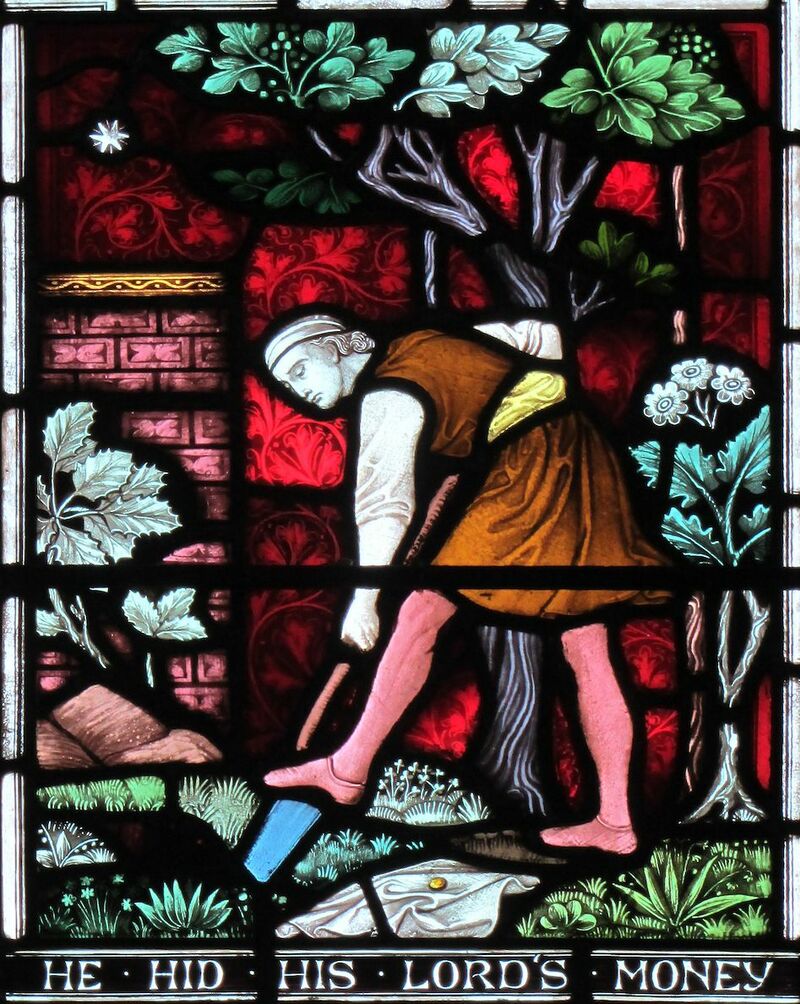
Image: He Hid His Lord's Money, from Art in the Christian Tradition, a project of the Vanderbilt University Divinity Library, Nashville, TN. https://act.library.vanderbilt.edu/artworks/57778 [retrieved November 15, 2026].
As we continue in Jesus’s three parables of the Last Judgment, we might be getting a bit anxious about what we’re hearing. Last week was the Parable of the Wise and Foolish Young Women, which ended in a locked door and barred entry for the five considered foolish, ostensibly for their lack of preparation, but perhaps more so for their anxious movement away from the groom in that last moment. This week, we hear what is usually titled the Parable of the Talents, though perhaps the money itself is not as important as it appears to be.
In any case, the instant Jesus tells one of these parables, we immediately try to find ourselves in it. The choice seems simple, doesn’t it? Are we like the slaves that used their master’s money wisely and well? Are we the kind of people that have the good sense and gumption to use what God has entrusted to us the sake of his kingdom? Or are we like the slave who is so terrified of his master’s wrath, so afraid of failure, that he elects the safest investment possible—burying his master’s money in the ground? Is that really what this parable is about—making the best use of God’s things? If so, this parable might have been better placed during our generosity campaign! You and I have heard many a sermon (and I have preached a few) about exactly that. God has entrusted certain gifts to us, so we better produce or else! But don’t be fearful about that! After all, with God, this is a “get-to”, not a “have-to”! Which should give us a clue about what’s going on in this parable.
Like I said last week, parables are not designed to illuminate—not primarily. They’re not intended to deliver the gospel to us. They’re meant to mess us up, particularly the part of ourselves that sees God’s grace as a deal to be achieved or a reward to be earned. They subvert our own thinking about who God really is and what his reign is really like. I have to commit a homiletical sin here by crossing gospels, but Jesus himself says as much in Mark and Luke, when he tells his disciples, quoting Isaiah 6:
“To you has been given the secret of the kingdom of God, but for those outside everything comes in parables, in order that
‘they may indeed look but not perceive,
and may indeed hear but not understand;
so that they may not turn again and be forgiven.’”
We may think of those who are “outside” as those who can only relate to God by what they have done or by whether they are a “good person” or not. In other words, they can only relate to God by the works of the law or personal performance. And remember, the law outlines God’s just expectations of us and only his expectations. Their questions would be these: Have they invested their master’s things well or not? And what would await them if they did not do well? While Jesus’ words are indeed harsh, they do indicate what happens when we relate to God solely based on our behavior. Forgiveness and new life are not possible when we stop at the law because forgiveness and new life can’t be earned. While God certainly has been in the forgiveness business from the beginning, it is very difficult, if not impossible, to receive forgiveness when we think our only hope is to be vindicated by our good sense, responsibility, and personal goodness. This describes our old sinful selves to a T, the sinful self drowned in the waters of baptism.
Rather, we are new people—people of the reign of God. People of the future. Paul writes about this in his letter to the Thessalonians. There is some similar scary language at the beginning of our reading, when Paul speaks of that day being like “a thief in the night” and that on that day “there will be no escape”. But again, Paul is speaking not of the beloved community of believers, but of those who can only relate to God on the basis of what they have done or failed to do, or who otherwise think God “will neither do good nor do harm”, as in the words of the prophet Zephaniah. Rather, Paul reminds us, we are “children of the day”. He continues, “God has destined us not for wrath,” not for being cast out into the darkness or rewarded on the basis of our earnings for the kingdom, “but for obtaining salvation through our Lord Jesus Christ, who died for us, so that whether we are awake or asleep,” that is, alive or dead, “we may live with him”.
Our God is the God revealed in Jesus Christ, who gave everything he was for us. Who was born in a frail, vulnerable human body like us; who lived with and among us; who suffered, died, rose, and ascended for us. God in Christ is not an absentee landlord like the master of the parable, but is present each and every time we hear his Word and share his body and blood. He entrusts his gifts to us to steward, not on the basis of terror, performance targets, or a corporate improvement plan, but on the basis of his love, grace, and forgiveness. And that forgiveness, grace, and love, first given us in baptism, continue to work in and on us our whole lives. When we really believe that we are not destined for wrath but for obtaining salvation, it changes our whole relationship with God in Christ through their Spirit. God is not a tyrant or an exploitative lord like the third slave thought, “reaping where he did not sow and harvesting where he did not scatter.” God certainly does entrust his gifts to us and empowers us to use them. But it is only when we are given the gift of faith in a God of mercy that we can do that well. As the first letter of John (here read in a combination of the NRSVue and the PDV—Pastor David version) so poignantly puts it:
Love has been completed among us in this: that we may have boldness on the day of judgment, because as he is, so are we in this world. There is no fear in love, but complete, whole love casts out fear; for fear has to do with punishment, and whoever fears has not been completed in love. We love because he first loved us.
God’s love gives us that boldness because we know who we really are. We are people of the gospel, people of the day, people who are bold to live on the basis of love. God continue to drive out the terrors and false images we have of him, so that we can continue to grow in faith, hope, and love he has given us. Thanks be to God. Amen.
© 2026, David M. Fleener. Permission granted to copy and adapt original material herein for non-commercial purposes.