
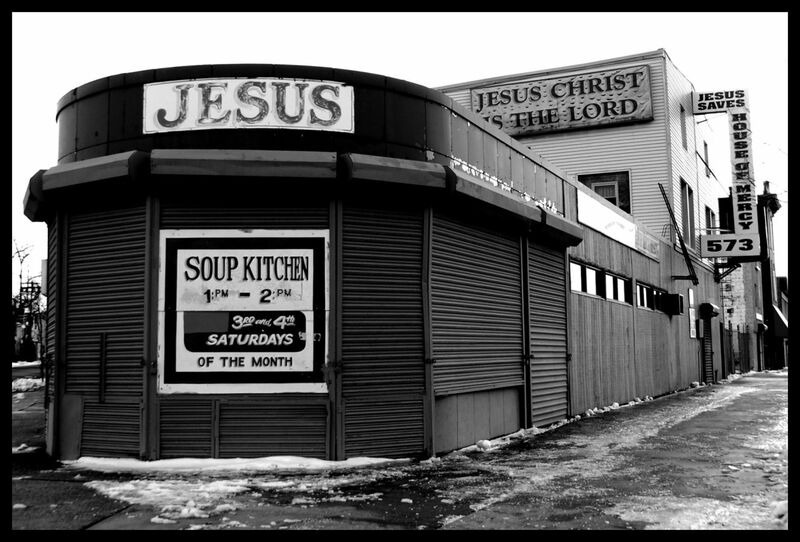
Image: Tony Fischer. Jesus Feeds the Hungry, from Art in the Christian Tradition, a project of the Vanderbilt University Divinity Library, Nashville, TN. https://act.library.vanderbilt.edu/artworks/57785 [retrieved November 22, 2026].
This year of Matthew ends with perhaps Jesus’ most evocative and provocative parable. Instead of a groom and maidens or a master and slaves, we have a shepherd king and flocks of sheep and goats, each with a different fate depending, it seems, on their actions. As with the other parables, once Jesus tells this one, we immediately try to see where we fit.
We might think, “I’m a reasonably good person. I come to church, I give, I volunteer. I’m doing the best I can. I know I mess up sometimes, but I’m not doing as badly as a lot of people! So maybe I’m not all sheep, but maybe I’m not all goat either. Maybe I’m an amalgamation. If so, how ‘goaty’ or ‘sheepy’ am I? I volunteered at the Food Shelf this week, so that’s pretty sheepy. But I also snapped at my daughter, and that’s pretty goaty! Do I have a sheep’s head but a goat’s body? Maybe I’m mostly sheepy but still have goat’s hooves! I would never say I’m all the way a sheep, but surely I’m not entirely a goat, right? Right? Right?”
Before this gets too silly, notice that this is often how we think about ourselves and our eternal destiny. No matter how often the gospel is preached to us, the old Adam or Eve (or, for today, the old goat) in us asks, “Have I done enough? Am I sheepy enough to enter the kingdom?” Or, to put it another way, “Am I a good enough person to go to heaven when I die?”
I know of a Lutheran lady who was very faithful. She worshiped every week. She was part of Bible study, and when I started to wax on about the background of the text, she would often ask, “That’s all very interesting, but what does that have to do with my soul’s salvation?” She gave. She served. She was the model of a faithful member.
Yet a couple of months before she died, she began to express anxiety about her eternal destiny. She was afraid she hadn’t done enough for Jesus to welcome her. Imagine that. Here was a lifelong Lutheran who, week after week, had heard that God makes us right with him not by what we have done, but by what Jesus has done. And still, I’m not sure she heard that the gospel was for her. She was stuck on whether she was a good enough person or not.
I have some bad news to start with, and you’re not going to like it. She wasn’t a good enough person, just as I’m not good enough, and you’re not good enough. It gets worse: not only are we not good enough, we also can’t make ourselves better. No number of works of mercy, however laudable, will do it:
• We can feed the hungry.
• We can give water to the thirsty.
• We can clothe the naked.
• We can visit the sick and imprisoned.
And we will still always miss someone. The shepherd king will always have a reason to say, “You did not do it to me.” We’re all goats, through and through, and there is no way to transform a goat into a sheep.
The Good News: God Kills Goats and Raises Sheep
At least, there is no way without going through death. That is precisely what happens in the waters of baptism. The old goat in us must die. It must be killed. Drowned. Destroyed. That’s why I often say at a baptism that we kill people at that font. The old sinful self must die completely, wholly, and utterly. God in Christ is in the business of killing goats.
But that isn’t all God does, or we would be doomed. God in Christ, by their Spirit, is also in the business of raising sheep. God works not just through creation, but through redemption by re-creation, the ultimate expression of both judgment and forgiveness. God doesn’t let us remain goats. As Revelation tells us, “…nothing unclean will enter [the new Jerusalem], …but only those who are written in the Lamb’s book of life.” Baptism into Christ’s death and resurrection is how God writes us in that book. In baptism God kills us as goats and raises us as sheep: a new creation empowered to do the works of mercy that Jesus calls blessed.
Yet throughout our baptized life, the old sinner in us thrashes about in its death throes. The theologian Karl Barth put it this way: “The old Adam in us is drowned in baptism, but the rascal knows how to swim.” That is why God in Christ gives us further gifts of grace: the Word of God, proclaimed here for us and given in, with, and under the bread and wine.
As Luther said in the Small Catechism, baptism in water “signifies that the old creature in us with all sins and evil desires is to be drowned and die through daily contrition and repentance, and on the other hand that daily a new person is to come forth and rise up to live before God in righteousness and purity forever.” The old goat in us dies daily through repentance, and the new sheep rises up to live before God in renewed, right relationship with God and neighbor.
We can trust that God in Christ, through their Spirit, will see this work through to completion. We are especially blessed at Shalom because the promise of that completion is in our name. Shalom is about ultimate well-being, not in a crude prosperity-gospel sense, but in the sense that the old, sinful person in each of us dies and a new person rises. The final completion won’t be fully perceived until the resurrection, but God’s mercy and grace are sure and certain.
We are shalom people, killed and made new in baptism and strengthened by the Word to be God’s people of mercy. Over the next church year, may God help us live more fully into our namesake, in faith that God has empowered us for that very purpose. As Psalm 22 ends,
Posterity will serve him;
future generations will be told about the Lord
and proclaim his deliverance to a people yet unborn,
saying that he has done it.
Amen.
© 2026, David M. Fleener. Permission granted to copy and adapt original material herein for non-commercial purposes.