
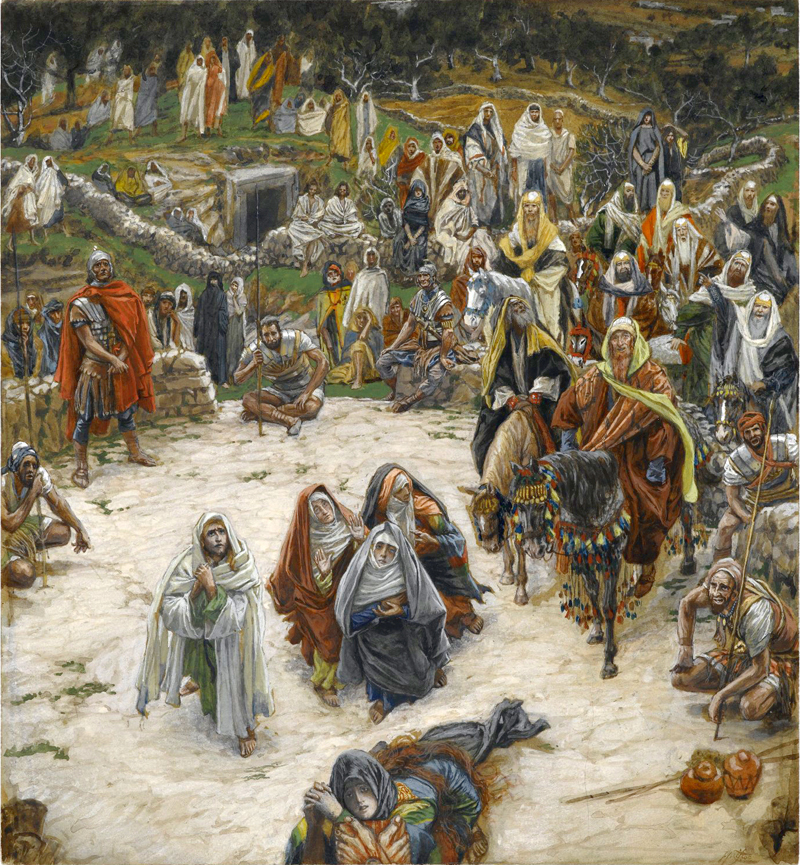
Image: James Tissot, 1836-1902. What Our Lord Saw from the Cross, from Art in the Christian Tradition, a project of the Vanderbilt Divinity Library, Nashville, TN. https://diglib.library.vanderbilt.edu/act-imagelink.pl?RC=58622 [Original source: https://commons.wikimedia.org/wiki/File:Brooklyn_Museum_-_What_Our_Lord_Saw_from_the_Cross_(Ce_que_voyait_Notre-Seigneur_sur_la_Croix)_-_James_Tissot.jpg.
That day in the praetorium, two lords and masters of their realm came together. One as judge and representative of the state, and the other as the accused, handed over by his own disciple to the religious authorities, who handed him over to Pilate. Pilate’s question is simple, clear, and direct. “Are you the King of the Jews?” In other words, “Are you yet another Jewish politician? Another revolutionary? Another insurrectionist? Another splinter in Rome’s foot that must be removed?
Jesus’ response is skillful, of course, and he turns the tables on Pilate. “Do you ask this on your own or did others tell you about me?” In other words, “Is this really your question or the question of someone else? Is it just a manipulation tactic to get you to do what others want?” Pilate is having none of this, of course, and he presses the question. After telling Pilate that his kingdom is not of this world, Jesus’s response is blunt: “You say that I am a king.” That’s Pilate’s word for it.
Jesus is the source and center of all that is, but to call him king is woefully inadequate. Earthly kingdoms nearly always end in disaster, whether they are great dynasties like those of France or China or puppet kings like Herod the Great or the former shah of Iran. The quintessential example is the Israelite monarchy, which as the prophet Samuel warned, would not go as the people hoped it would:
These will be the ways of the king who will reign over you: he will take your sons and appoint them to his chariots and to be his horsemen…[and he will appoint] some to plow his ground and to reap his harvest and to make his implements of war and the equipment of his chariots. He will take your daughters to be perfumers and cooks and bakers. He will take the best of your fields and vineyards and olive orchards and give them to his courtiers. He will take one-tenth of your grain and of your vineyards and give it to his officers and his courtiers….He will take one-tenth of your flocks, and you shall be his slaves. And on that day you will cry out because of your king, whom you have chosen for yourselves, but the LORD will not answer you on that day.[1]
And just as Samuel warned, the Israelite monarchies ended badly. Nearly every king in the books of Samuel and Kings is judged poorly. Even the good kings, like David, Solomon, and Hezekiah, inflict great suffering on their people through their failures of character. Kings take taxes and people. Kings raise armies and wage wars. Kings rule by force or manipulation. Kings, from every time and every culture, are usually self-serving and short-sighted.
Jesus does none and is none of those things. At least, he doesn’t do them after the way of the world. Jesus stands before Pilate with only the power of the Word, the Word that he embodies. And in that Word is the only truth in a world full of lies—lies which have made Pilate so cynical that he can only sneer, “What is truth?”
After all, Pilate, like us, is a man of the real world. Pilate knows that in the world, there are only the strong and the weak. The strong are the ones who make things happen. Pilate’s credo is quite simple. It’s the same as the ancient historian Thucydides, who wrote in his History of the Peloponnesian War, “The strong do what they can and the weak suffer what they must.”
But Jesus is the inversion of all that. Jesus, God Incarnate, empties himself of his glory to become human. He enters our world, not as a conquering king after the way of the world, but as God’s own Lamb who will carry our sin even to death on a cross. All the way back in John chapter 1, we learn this. We learn what it means to call Jesus God’s Anointed One, or Messiah. It means, in John the Baptist’s words, that Jesus is the Lamb of God who takes away the sin of the world. From the beginning of his ministry, Jesus will be faithful to that mission. And through taking away our sin—which is not just what we do wrong, but the whole desperate, disastrous situation humanity finds itself in—Jesus becomes our way to his Father and our Father. Jesus shows us truth that reveals that there is more than the lies the world tells about itself and us. And in being our way and truth, Jesus gives us his life. John’s Gospel calls it eternal life, or a “life of the ages”. This isn’t life continued indefinitely on human terms. If it were, we might just call that hell! This is a radically different kind of life, a life we have when we are drawn to Jesus, just as he says to Nicodemus in John chapter 3 and to the crowds in John chapter 12. The life we receive from Jesus refuses to believe that the world we see is all there is. That life that begins at our baptism and continues throughout the ages. That life has Jesus at the center, not as our earthly king, but as our Lord, Lamb, and Friend.
And it is the Spirit he sends to us that makes it possible to see his victory won through the cross. Without that illuminating Spirit, we can only see the cross as failure. But with Spirit-given faith, we see the cross very differently. It is the end of our sinful selves and the rising of the new person. It’s no accident that a new community is created at the very foot of the cross, as the beloved disciple takes Jesus’ mother into his own home as his own. Jesus, even on the cross, continues God’s faithfulness by making faith a reality. And that faith is a counter to the so-called “real world”. Because we know that in the end, the love of God shown us in Jesus’ death is our ultimate reality. Amen.
© 2026, David M. Fleener. Permission granted to copy and adapt original material herein for non-commercial purposes.
[1] 1 Samuel 8:11-15, 17-18.