
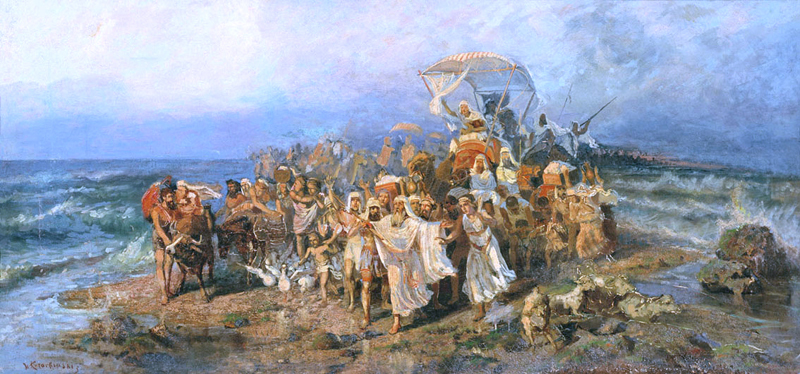
Image: Kotarbiński, Wilhelm, 1848-1921. Crossing the Red Sea, from Art in the Christian Tradition, a project of the Vanderbilt Divinity Library, Nashville, TN. https://diglib.library.vanderbilt.edu/act-imagelink.pl?RC=57377 [retrieved April 12, 2026]. Original source: https://commons.wikimedia.org/wiki/File:KotarbinskiyV_PerehEvreRYB.jpg.
A long time ago, God’s people were captive to the Egyptian empire. The Egyptian pharaoh regarded himself as a god, able to do whatever he liked with his subjects. And this extended itself to the divine realm. When commanded by God to let the Israelites go, he snarled at Moses, “Who is the LORD, that I should set Israel free? I do not know the LORD and I will not let Israel go.” To Pharaoh, God was a weak tribal god unable to challenge his mighty empire.
But over the course of ten plagues, God humiliates the pretender god Pharaoh. The humiliation is so complete that Pharaoh kicks the Israelites out of Egypt. A long-oppressed, harassed, and harried people leaves Egypt behind, burdened with their neighbors’ wealth.
The humiliation isn’t quite complete, though. Not long after the Israelites’ departure, Pharaoh has second thoughts. He musters his cavalry and rides out to compel the people back into his service. The Israelites find themselves trapped between the Egyptians and the sea. So, God delivers his people—and delivers the final blow to the empire. The people cross on land and the Egyptian chariots. are swallowed up by the watery abyss.
That’s what Moses and Miriam’s ancient song of praise celebrates: God’s mighty deliverance of the people from re-enslavement and death. The people were now free to be God’s people, with no other gods and no other masters. It’s hard to exaggerate how foundational this story is, both to Jews who see it as a cornerstone of their identity, and to Christians who see this as a master narrative of God’s mighty power to save.
God is indeed mighty to save. But that mighty power may be better seen today in less flashy but no less powerful ways. God might not literally part the sea for you or me. But God in Jesus Christ continues to deliver us from all things that seek to destroy us: sin, death, and the devil. The new kind of deliverance pierces the heart of those things and empowers us to live free, just as the Israelites were empowered. That deliverance is the power to be forgiven and to forgive.
And we need that power, especially in our merciless age. You can say something wrong and find yourself ghosted, without any idea of what happened. Make a mistake on social media and you might find yourself ostracized. Send the wrong picture to the wrong person and you might find yourself humiliated. Our culture has no place for mercy or forgiveness. Quite the opposite. The credo seems to be: Never admit wrong and always attack everyone else. This is true from the highest leadership positions to recording artists. Remember the 2025 Superbowl Halftime Show? “Not Like Us” by Kendrick Lamar is a brutal, if catchy, revenge track. (Unless some of you think you’re above that, I’ll remind you of Nancy Sinatra’s “These Boots Are Made for Walkin’”!) Getting even is seen as strong. Powerful. Admitting wrong? Forgiving someone? That’s just making yourself unnecessarily open to attack, isn’t it?
When we feel wronged, we can be tempted to hold onto things for a very long time. Sometimes there’s a kind of perverse enjoyment in holding onto past wrongs suffered. Few things keep us as stuck on ourselves as unforgiveness. The author and theologian Frederick Buechner put it this way:
Of the Seven Deadly Sins, anger is possibly the most fun. To lick your wounds, to smack your lips over grievances long past, to roll over your tongue the prospect of bitter confrontations still to come, to savor to the last toothsome morsel both the pain you are given and the pain you are giving back — in many ways is a feast for a king. The chief drawback is that what you are wolfing down is yourself. The skeleton at the feast is you.[1]
But Jesus gives us a new kind of life, a new kind of heart. And it began the Sunday evening of his resurrection. Jesus had every right to be furious with them. Nearly all of them had abandoned him. Only the beloved disciple remained at the cross. So, you can imagine their terror when Jesus shows up. Is he going to get even? Is he going to give them (and pardon the expression) a “come to Jesus” talk? That might be the best they could hope for. It might go something like this: “Guys, you really messed up. I told you this would happen, but you didn’t get it and you ran away. Now, I’m willing to take you back, but you need to straighten up and fly right this time!”
Jesus doesn’t do that. Jesus doesn’t get even and he doesn’t give them a lecture. Jesus gives them his peace. And when Jesus gives them his peace, he delivers them from their failures. From their sins. From their fears. But he does more than that. Jesus also delivers them from their powerlessness to forgive others. Jesus breathes the Spirit on them, empowering for this work.
And Jesus does the same for us contemporary disciples. Just as Jesus gave the first disciples his peace, not once but twice, Jesus also gives us his peace. Jesus delivers us too from our sins and our fears. But Jesus also empowers us by giving us his Spirit. The Spirit of God is given to us in baptism, at this table, and in the Word. And that Spirit empowers us to forgive others. To speak Jesus’ peace to our neighbors.
Now, that can be hard. Often, many questions come up around forgiveness, like, “Do I have to forget what was done to me?” or “What about murder or abuse?” or “Do I have to continue a relationship with this person?” These questions often come from places of deep hurt, anger, or fear. Sometimes forgetting can be dangerous, difficult, or impossible this side of heaven. Sometimes for one’s health and safety, some relationships may need to end. But let’s be honest. Most sins done to most of us are not major sins with catastrophic consequences. Not everything done to us is a trauma. And the reverse is true. Most sins don’t have catastrophic consequences. But we still need forgiveness for them and we are still called by God to forgive others. Everyday sins can build up over time. Unless they are addressed and forgiven, disaster can result. For example, most marriages are not destroyed by one major transgression, but by thousands of minor ones. The major transgression, if there is one, is usually the result of the others. We often cling to ordinary, everyday sins, as if they contained our identity. By holding on to them too long, we remain enslaved and defined by them.
But Jesus delivers us from all that. We are no longer defined or controlled, either by what happened to us or by what we have done. Rather, we have received his peace which gives us real power. And the power to forgive and be forgiven is the power to be free. No longer are we defined by grievance or another allegiance. No longer are we ruled by fear, contempt, or hate. We have Jesus’ life that makes us free. Amen.
© 2026, David M. Fleener. Permission granted to copy and adapt original material herein for non-commercial purposes.
[1] Frederick Buechner, Wishful Thinking: A Theological ABC, Harper and Row.