
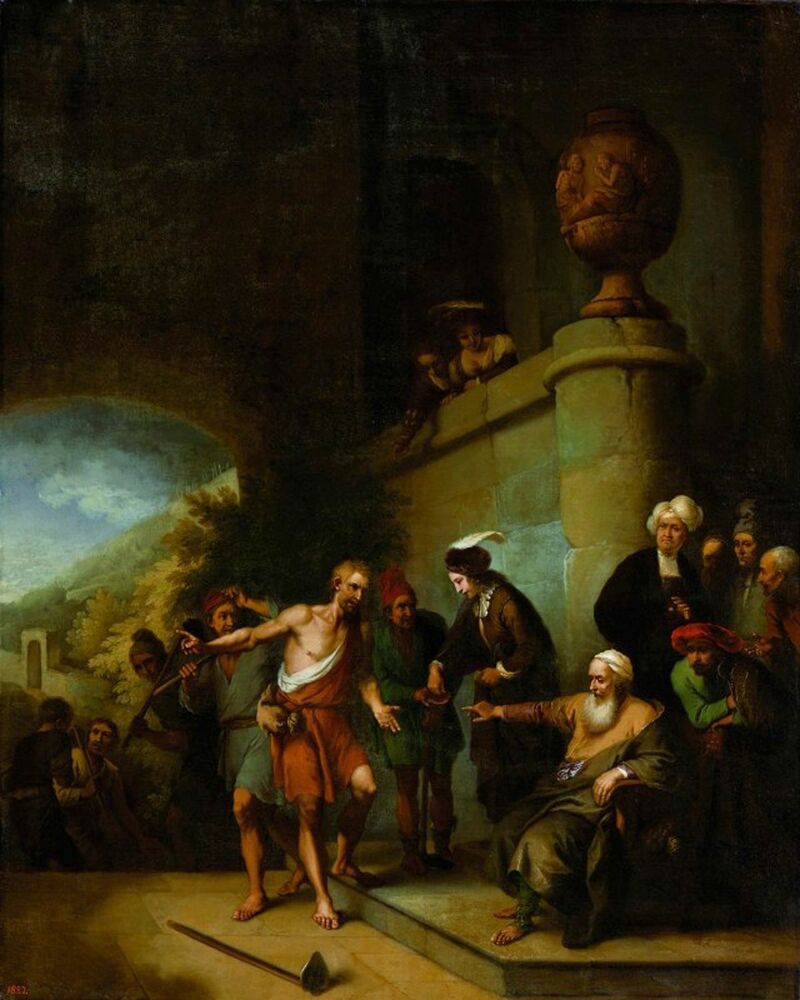
Image: Christian Wilhelm Ernst Dietrich, 1712-1774. Parable of the Workers in the Vineyard, from Art in the Christian Tradition, a project of the Vanderbilt University Divinity Library, Nashville, TN.
How many of you have or had siblings? How many of you have heard or proclaimed the classic cry of lament, “It’s not fair!” All of you have heard it, of course. When I was growing up, my little sister liked to bait me. I would react, and then of course I got in trouble for it! It wasn’t fair! (She dealt with the same thing with my little brother.) And I would hear the corollary that goes with “It’s not fair!” “Life’s not fair!”
In one respect, it’s a gift of God that we have a sense of right and wrong, acceptable and unacceptable, just and unjust. Without an idea of fair or unfair, civilization is impossible. Accountability is impossible. Life together in any form is impossible. Football is impossible! (Though we might have differing definitions on what’s fair!) Fairness is a glue of community.
However, fairness can be warped. Partisans and politicians invoke fairness all the time to rally people to their cause, and the fair society they present is often deeply unfair to others. The sense of suffering injustice along with a sense of powerlessness creates resentment, suspicion, and mistrust. Case in point: In 2020, amid the turmoil of COVID and George Floyd’s killing, firearm sales reached an all-time high in this country of around 22 million. While it has dropped every year since then, the first six months of 2026 saw sales of around 7.7 million. And since 2010, there been around 246 million guns sold, one for every 1.5 people![1] There aren’t 246 million hunters in the country, I can assure you! Suspicion, mistrust, and resentment of our neighbors has grown, at least in part out of a sense of unfairness.
Yet, when Jesus tells today’s parable, he kills our entire sense of fair and unfair.
We need to remember that Jesus told the disciples this parable after the encounter with a rich man who insisted he had kept all God’s commandments. In response, Jesus tells him to sell everything, give to the poor, and follow him. This stunned the man and the disciples alike. After Jesus continues to say how hard it will be for a rich person to enter the kingdom, Peter pipes up. Again, perhaps a bit of virtue-signaling, but it’s understandable. “Look, we have left everything and followed you!” For his part, Peter has left his family and business behind to follow Jesus. Peter’s question is ours: Will there be something for us at the end of all this? Will we be taken care of?
And Jesus tells this parable. Now, it’s important to remember that Jesus isn’t trying to correct behavior here. None of the parables are for correcting behavior. Parables are meant to kill. They’re meant to kill the old sinful self that wants to believe that we can earn our way with God or game God. That’s what he does with the rich man earlier and that’s what he does here.
First off, when the landowner hires the first laborers, they agree on the usual daily wage, a denarius. That amount of money would have provided for a family for one day. That was a fair day’s wage for a fair day’s work.
Second, the landowner is the one going out to hire workers. They don’t show up at the vineyard and demand to be hired. The ones hired at five o’clock aren’t lazy or trying to game the system. They simply haven’t been hired.
Third, the landowner makes a point of paying the last hired first. He could have paid them after the first and no one would have been the wiser. The landowner wants to make a point.
And the point is this: when we serve God, our usual notions of fair and unfair don’t apply. Everyone receives the same. This is offensive. Just as it made the laborers hired first angry, it can make us angry too. The cry “You have made them equal to us,” from the first laborers is often our cry. Those people? Really? They’re equal to us? Haven’t we been faithful, Lord? Haven’t we served you at all those BBQs and bazaars, teaching Sunday school and visiting the sick, praying and providing meals for homebound folks, serving on committees and Council? Haven’t we worked hard and done the right things? I remember a lady close to the end of her life who lamented, “But I did everything right!” So do we often think.
Such a leveling was also offensive to Jonah at Nineveh so long before. Remember that Nineveh was the capital of the hated Assyrian Empire, which laid Israel and Judah waste during the eighth century B.C. A good Israelite or Judahite would have had every reason to hate the Assyrians, which is why Jonah doesn’t want to go in the first place. Jonah eventually is compelled by the help of a storm and a big fish to go to Nineveh where he preaches the shortest sermon ever: “Forty days more and Nineveh overthrown!” (A close second would be the sermon an old firebrand preacher once gave on a hot summer day: “If you think it’s hot here….” That was the whole sermon!) But by the Spirit of God, it was also the most effective. The people repented immediately. So when God changes his mind about the disaster he plans to bring on Nineveh, Jonah is infuriated. “I knew you were like this God! I knew that you’re merciful, slow to anger, abound in loyal lovingkindness! And that extends even to these people! It’s not fair! Don’t you remember what they did to us?”
But God did see and does see. And God provides us with more than we can even imagine, especially mercy. Grace indeed makes us mad when it’s shown to other people. It can make us mad when shown to us, especially if we think we have nothing to repent for. But nothing can be earned with God. Nothing, ultimately, is ours. And that is freeing. We are freed from our old ways of having to earn with God. And that offensive grace is given to us from the moment of our baptism. Most of us were baptized as babies. When we couldn’t speak for ourselves, when we couldn’t choose, when we had no power or control over anything, God chose us. (That’s also true for us baptized when we were older.) God chose us. God, we might say, came out to the marketplace and hired us, saving us from the anxiety of the marketplace. By his grace, we all have a job to do in his vineyard. That is radical grace, the grace that saves. And yes, at its root, it is deeply unfair in our favor. Amen.
© 2026, David M. Fleener. Permission granted to copy and adapt original material herein for non-commercial purposes.
[1] https://www.safehome.org/data/firearms-guns-statistics/.