
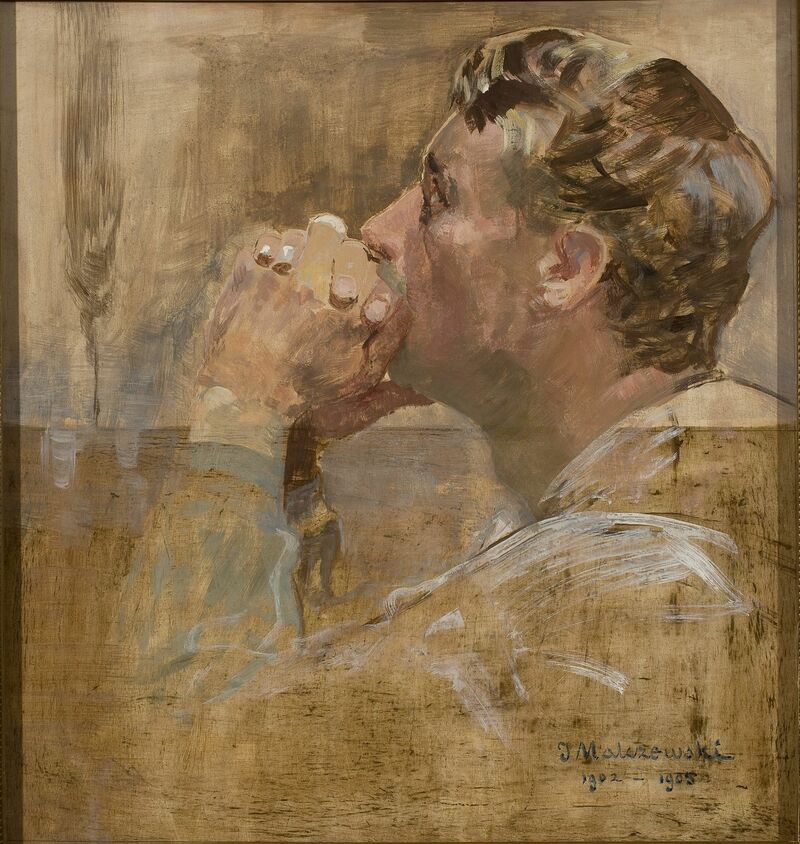
Image: Jacek Malczewski, 1854-1929. Praying Man, from Art in the Christian Tradition, a project of the Vanderbilt University Divinity Library, Nashville, TN. https://act.library.vanderbilt.edu/artworks/59723 [retrieved October 11, 2026].
Most of you remember our beloved member Roma, who died two years ago on October 3. Roma was a pillar of our congregation. She had a deep prayer life, was involved in our home communion ministry, WELCA, and led a prayer group at Shalom. I always experienced her as gentle, quick with a laugh, and with a depth of care that came from more than just her decades as a nurse. One year, I was going through a pretty tough time. I don’t think I had told her that, but she sent me a card with a note saying that the Holy Spirit had nudged her to send it immediately. Like many of you, I miss her greatly, even though she is finally enjoying her room, as she said (she often joked that God was taking his time to get her room ready!).
But the reason I bring up Roma today is that Philippians 4:6-7 were guiding verses in her life. She had them read at her funeral. At first, I was going to extend the reading back to verse 4, but something nudged me, “Roma knew what she was doing.” And those verses were spoken at her funeral, right before the 2024 election. (And for me and my family, not long after both Abigail’s illness and Tom’s sudden death.) Paul writes, “Don’t be anxious about anything, but in everything by prayer and supplication with thanksgiving let your requests be made known to God. And the peace of God, which surpasses all understanding, will guard your hearts and your minds in Christ Jesus.”
Easier said than done, though. Anxiety is a constant in our lives. To be sure, it’s been that way for a long time. I can only imagine the anxiety of the Cuban Missile Crisis or nuclear drills where you took cover under your desk! But anxiety seems to have risen exponentially in the past few decades, especially since 9/11. That day, we felt vulnerable and frightened in a way we hadn’t felt before. It seems we’ve been controlled by fear ever since. The constant message from media and leadership seems to be, “Be anxious. Be very anxious. Be anxious about Muslims. Be anxious about gay and trans people. Be anxious about immigrants. Be anxious about Democrats. Be anxious about Republicans. Be anxious about the President. Be anxious about Russia. Be anxious about China. Be anxious about hidden, shadowy, unprovable conspiracies. Be anxious about AI. Be anxious about people who disagree with you. Be anxious about your neighbors.” When the drumbeat of anxiety is constantly struck, it makes us desperate to find someone or something that can take it away.
Surely, the apostle Paul himself would have had a lot to be anxious about. He was in a Roman prison when he wrote to the church at Philippi. He knew what awaited him. He’d been charged with sedition and insurrection, among other crimes. And even the barest whiff of sedition and insurrection were met with overwhelming force. Even though Paul had no intention of starting a rebellion against Rome, he did have a habit of stirring up public disturbances wherever he went. (See the book of Acts for more details.) His final trip to Jerusalem was the last straw, culminating in a riot in the Temple. After his arrest, Paul had endured a difficult journey to Rome, including shipwreck, continued dissension among the churches he planted, and abandonment by some of his colleagues. If anyone had a right to be anxious, it was Paul.
And yet, the note Paul strikes in Philippians is joy. Joy in the church at Philippi which is sharing in his suffering and providing for his needs in prison. Joy in their faithfulness to him and to their Lord. And joy in the Lord himself, who descended into our realm and was obedient to the point of death—even death on a cross. This is a joy that once struck a professor of mine as exceedingly odd, perhaps even psychologically unexplainable. Paul’s joy is not tied to his present circumstances at all. It is not tied to whether he lives or dies. It isn’t even tied to his own success or failure. It is rooted in the Lord Jesus Christ who claimed Paul as his own, and who in our baptism, claims us too.
Perhaps that’s a helpful way to look at the disturbing parable we hear in the gospel reading today. There’s a lot to not like about this parable! We might wish it were a little less bloody and a little more grace filled. Luke’s version, after all, ends with the mass invitation. It doesn’t include an epilogue about a man appearing to wear the wrong clothing. And yet, we know that in Christ, we don’t just receive an empty invitation to be like him or to follow him. We’re not baptized with mere encouragement or sent out with a platitude like “do your best”! That would be putting on us an impossible burden to bear, something Jesus castigates the religious leaders for doing. No, in baptism, communion, and the proclamation of the Word, we receive the very life of Christ. We receive pure, radical grace, without condition. The “catch” is that such radical grace does change us by its very nature. When we receive grace, we receive repentance and change. We receive growth in his love and faithfulness, which continues our entire lives.
So that tells us that this man must have refused to wear the garment he was given. It would be like Paul encountering Christ, only to prefer his own pedigree and blameless life according to the law of God. Such a life can only increase anxiety and fear because we have to always be performing. We always have something to prove. It’s all about doing things our way, being right at all costs. That’s not life lived in Christ. We don’t receive Christ on our own terms. And when we receive Christ, we receive that radical grace that makes all our own achievements like sewer trash in comparison, to use Paul’s memorable phrase back in chapter 3. Don’t misunderstand me—this isn’t to say that we don’t ever do anything right or worthy of praise. This is to say that our relationship to Christ is as receiver, not giver. We let go of everything we have when we receive everything that he is. Or, as C.S. Lewis put it in his classic Mere Christianity:
“The more we get what we call 'ourselves' out of the way and let Him take over, the more truly ourselves we become. In that sense our real selves are all waiting for us in Him...Look for yourself, and you will find in the long run only hatred, loneliness, despair, rage, ruin and decay. But look for Christ and you will find Him and with Him everything else thrown in.”[1]
So, back to Roma. Roma knew about the radical grace of Christ that had called her to be his own, and it freed her in amazing, impactful ways. So reclaim your freedom today when you receive Christ today in bread and wine, let him free you from your anxieties and fears, and trust that he has you in his hand. When we let go, we become who we were meant to be. Amen.
[1] C.S. Lewis, Mere Christianity (New York: Touchstone, 1996), pp 190-191.