
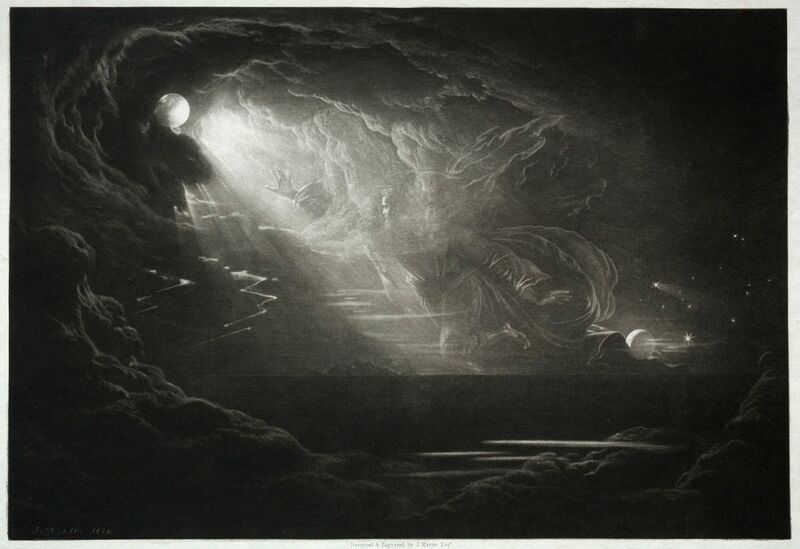
Image: John Martin, 1789-1854. Creation of Light, from Art in the Christian Tradition, a project of the Vanderbilt University Divinity Library, Nashville, TN.
It’s hard to count the number of bad analogies I’ve heard (and I confess, used) to talk about the Holy Trinity. There’s the three states of water analogy—water can be a solid, liquid, or gas. There’s the man analogy: a man can be a husband, a father, and a son. Or the egg, which consists of a shell, a white, and a yolk. There’s also the tri-corner hat, the heat, light, and gas of a star. Or even, with apologies to St. Patrick, the shamrock. (By the way, if you want to have a little fun, look up “St. Patrick’s Bad Analogies” on YouTube.) The problem with all these analogies is that they fall into one falsehood or another about God. The Trinity is not merely three aspects of the same God or parts of God. It isn’t three ways that God reveals himself to humanity or emanations of God. Such analogies not only miss the mark, but they also harm our understanding of God.
And the worst aspect of such misunderstanding is our drive to domesticate God. We can’t help but try to make God into an obedient pocket deity who will do what we want when we want (or who at least won’t be a problem). Such a domesticated image of God is everywhere, from putting God on our money to the prosperity gospel, which you could call the vending machine gospel. And the vending machine gospel is just another way we try to control and manipulate God for our own purposes. I put a prayer in, I get a divine reward for my trouble. I give some money, I get another reward. If we can just understand how God works, our fallen selves reason, we can make things good for ourselves. If I go to church on Sunday, am I not doing better than most people? Am I not showing God my faithfulness? If I pray or read a few Bible verses, doesn’t God take notice of that? If I give money to the congregation or to other charities that do good work, won’t I be rewarded for that?
Such a view of God is not relational, but manipulative. But God cannot be manipulated or gamed. Controlling God is not our job. The Triune God, Father, Son, and Holy Spirit, is neither a formula nor an abstraction to be used, but a loving relationship to be entered into. God: Father, Son, and Spirit, is perfect community in perfect unity, bringing us lost human beings into a saving relationship with him through our baptism.
Such saving relationality was present from the beginning of creation. The Spirit hovered over the waters of chaos, waiting to receive the Father’s Word. And the Father did speak, sending out His Word—the Son—to the Holy Spirit, who receives that Word, making creation a reality. God speaks light, and there is light. God commands the waters to separate, and there is sky and land. God speaks life, and there is life. The Holy Trinity is active from the beginning to bring the universe into existence, including making us in the very image of God. We are created not out of an act of violence or as slaves for the gods, as the ancient Babylonians believed, but as sons and daughters of God with a dual purpose: to care for creation and for one another.
And God continues to invite us and all people into that loving relationship, not out of any worthiness on our part, but out of pure grace. And where do we receive that pure grace? In baptism.
This is one of the things we mess up about the so-called Great Commission here at the end of Matthew’s Gospel. We take a beautiful statement of gospel and we turn it into an “ought” or a “should”, trying to take control of something that is God’s work. Or, we might fall into despair when we don’t do as well at making disciples as we think we should. We “should” all over ourselves. But we don’t need to do that. God: Father, Son, and Spirit bring people to faith, not us. Jesus indeed says “Go and disciple all nations,” but that doesn’t mean that we have to have an awesome building with a coffee bar to attract people to the gospel. It doesn’t mean we have to have the best worship band or the most inspiring (and most marketable) worship experience. It doesn’t mean a line of merchandise. It doesn’t mean having the most charismatic pastor and staff. It doesn’t mean having a million-dollar budget. It doesn’t mean having all of children and youth. And it sure as heck doesn’t mean making a relationship with the institution the defining mark of someone’s identity.
The way we go into the world is with the promises of baptism, which God carries out. We are just privileged to be the instruments by which it is done. To be sure, baptism seems embarrassingly ordinary. You have the baptized, witnesses, and water there. The pastor says some prayers, pours some water over someone’s head, and if the baptized is an infant, everyone oohs and aahs. It makes for good photos to send to grandma. But the appearance belies what is happening. At that font, a creation-level event is taking place. The Triune God is present, just as he was in the beginning. Through the mouth of the pastor, God the Father speaks the Word, Jesus Christ, which is received and acted on by the Holy Spirit, hovering over these waters just as he did at the beginning of time. And the person baptized is re-created from the inside out. A new person is born at that moment, in the image of Christ. To be sure, we struggle with sin all our lives. That’s why Jesus doesn’t just say to baptize. He also says to teach. In other words, keep giving people Jesus, the Word of God. Keep being God’s instruments by which the saving Word is voiced, received, and acted upon. This is not trying to take on God’s work for ourselves. This is simply giving of ourselves wholly for the purposes of God’s saving work. It’s all God’s work. We’re invited to be a means by which it is done.
So, we don’t have to control the work of God. We don’t have to coax people into it. God’s Spirit blows where he will and will create faith where he will. We are blessed to be part of that faith formation. And all faith comes back to baptism. That is where we introduce people to Jesus. That is where we are washed, forgiven, and made part of our heavenly Father’s family. That is where the Spirit descends upon us, making us new. It’s that simple. Amen.
© 2026, David M. Fleener. Permission granted to copy and adapt original material herein for non-commercial purposes.
