
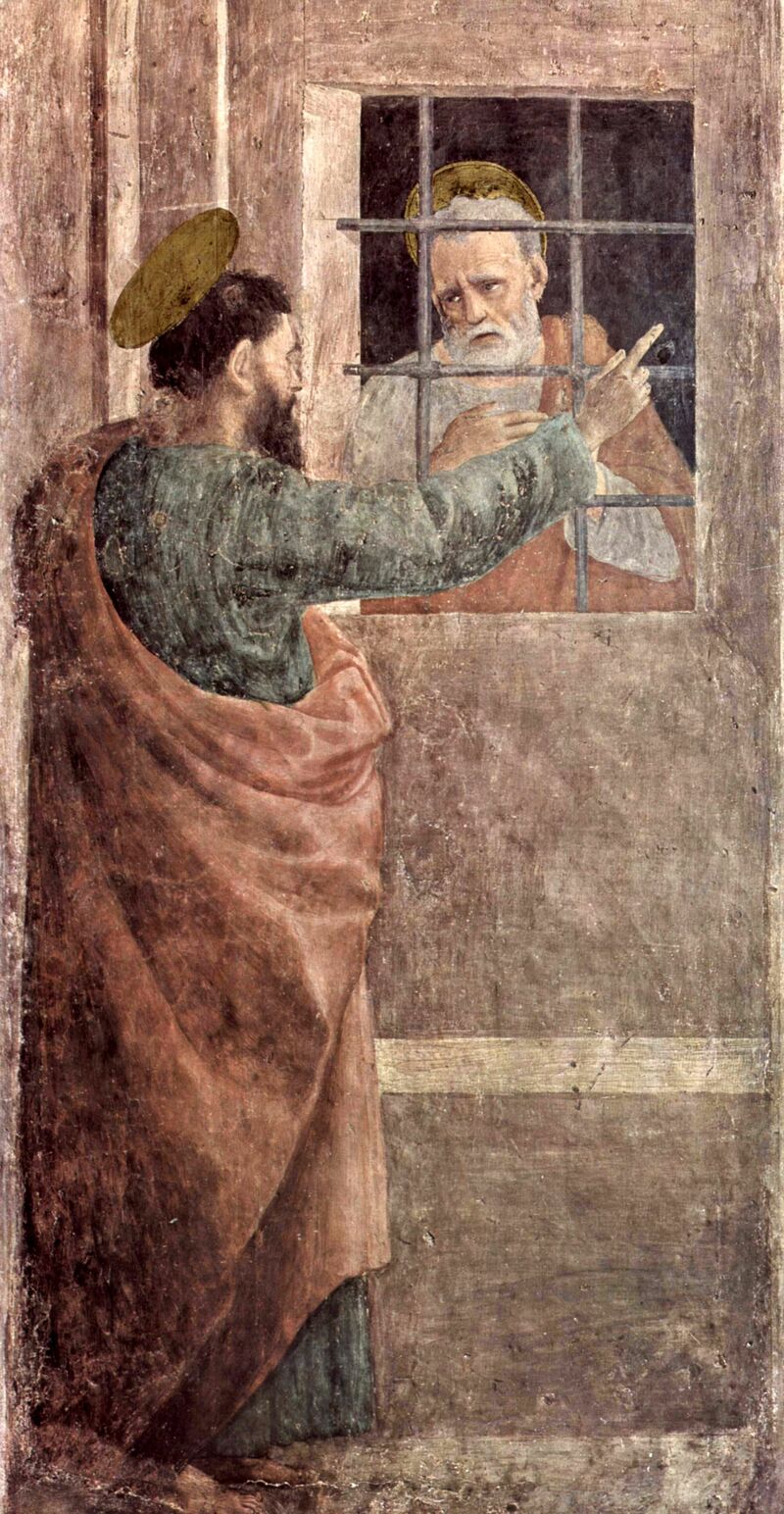
Image: Filippino Lippi, d. 1504. Paul Visits Peter in Prison, from Art in the Christian Tradition, a project of the Vanderbilt University Divinity Library, Nashville, TN.
There’s a perennial half-truth about Christians that pops up when someone wants to dismiss Christian community altogether. It’s this: “The church is full of hypocrites! Why would I want to be part of a group that preaches love but practices hate?” To a degree, we can have some sympathy for this way of thinking. The church is indeed full of hypocrites, all of us included, who are guilty of saying one thing and doing another. But the part that’s often left out is that every single person who has ever lived or who ever will live, except for Jesus, is guilty of hypocrisy. Sure, we can and ought to expect better from the church. But it takes a long time to fully destroy the old Adam and Eve—the old person—within us. It doesn’t matter how good or right or holy someone is. Everyone has done this, even the greatest apostles.
Poor Peter is, yet again, the example for today. This, again, is one of the reasons I love the Bible so much. It’s made up of real people. Flawed, fallible people. Peter had seen the risen Christ. He had been given the promised Spirit. Real and dramatic change had occurred in him. The frightened denier of Christ became the bold champion of the faith before governors and councils. By the grace of God, he did amazing acts of healing. He had a vision that confirmed God’s intentions for the gentiles (that is, for non-Jews). That vision told him that he should no longer call anyone or anything profane or unclean. And yet, that old, fearful creature in him still rose up from time to time. This time, it seems that Peter was afraid of representatives from the mother church in Jerusalem.
More so in the ancient world than today, community was established by breaking bread together. Sharing a meal meant a great deal. It meant trust and equality. If the apostles were to reach gentiles at all, they would have to eat at their tables, which meant eating non-kosher food. This was a huge hurdle to overcome. Imagine being told all your life that certain foods, clothing, and hairstyles were fine and others were not. Or that you should associate with only a certain group of people. How easy do you think it would be to change your thinking? Probably not so easy, right? This was the exact situation in the early church.
And through the Spirit had led the way, it took the church some time to catch up. Some people from the Jerusalem church were appalled that dietary laws and circumcision were not insisted upon for gentiles. After all, those behaviors, those works of the law, were also necessary, right? Jesus had opened the door for them, sure, but other things were also needed. This was likely how these folks pressured Peter when they saw him eating with gentiles.
But Paul will not add anything else to faith in Christ. He opposes Peter, not privately, but publicly for his vacillation and people-pleasing. The problem isn’t Torah observance, but its misuse to keep gentiles from Christ. And that leads to hypocrisy of being one way with gentiles and another way when people from the Jerusalem church are present. And of course, if anyone knows hypocrisy, it’s Paul! He himself had been big on observing the law but had no trouble with destroying lives before Christ knocked him flat on Damascus Road. Paul knows hypocrisy when he sees it. The faith of Christ, Paul says, is enough, no matter what others might think.
However, our old fallen selves don’t want to believe this. We are often captive to the opinions of others, as Peter was. We often think something else is needed in addition to faith in Christ, like faith in a particular set of beliefs. Faith in a particular person or persons. Faith in a particular narrative. And I’m not just talking about the people we might disagree with or their beliefs. All of us would do well to look at those beliefs we think make us part of a chosen people. But our fears often keep us from doing this. We might ask, “What if I lose who I am?” There’s a reason Jesus told a parable about wine and wineskins. When we cling to our old ways, it’s impossible to accept grace. It takes the Spirit to make the old wineskins of our hearts new again, able to accept the new wine of the gospel.
But the truth is that Jesus is enough. The faith of Jesus Christ in his Father God is enough to save us. And that same faith is given to us, not as a task to be accomplished but as a gift. To be sure, such faith can’t help but change us. Paul will talk about that more later in the letter. But for now, he will not yield on this point. If we could make ourselves right with God by our behavior, a few would have done so. If God’s Law could make us right with God, that would have happened already. But that’s not what happened. Instead, the opposite happened, which Paul elaborates further in his letter to the Romans: that through God’s law comes the knowledge of sin. In other words, with God’s law we know just how bad we mess things up! But through that law, we know how desperate our need is for grace, which is nothing less than the forgiveness of God. We also know how much our consciences long for genuine peace, which only comes when we receive God’s forgiveness. In that, we have a new life, freed from the terrors of conscience. Freed from people-pleasing. Freed from vacillation and hypocrisy. Freed from the tyrannies of ideology and politics; from the cancel cultures of left and right; from hate and fear. And freed to live boldly, following Jesus.
That new life is given in baptism and fed at the communion table. So, receive his grace and peace here today. And be strengthened and renewed for that new life. Amen.
© 2026, David M. Fleener. Permission granted to copy and adapt original material herein for non-commercial purposes.
