
|
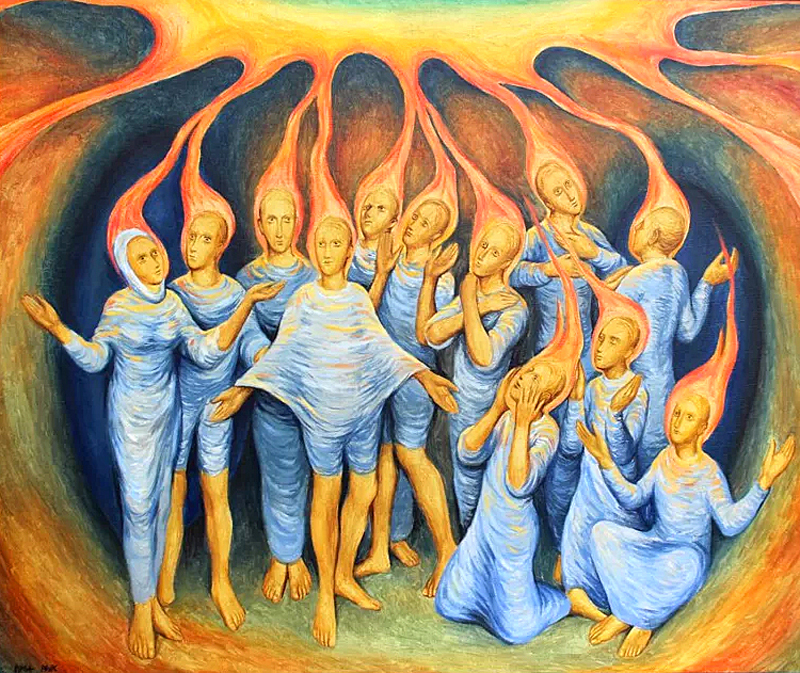
Image: Koenig, Peter. Pentecost, from Art in the Christian Tradition, a project of the Vanderbilt Divinity Library, Nashville, TN. https://diglib.library.vanderbilt.edu/act-imagelink.pl?RC=58542 |
You know, I didn’t plan for the last couple weeks to turn into the “not your job” sermon series! It continues to amaze me how these texts can speak in different ways depending on the state of the world, the state of our communities, and our own personal ways of understanding.
But it strikes me this week that when you get down to it, like unity, forgiveness is not our job. Sure, there are commands to forgive in Scripture. Jesus tells us to forgive 7x70 times in Matthew’s Gospel. He also makes God’s forgiveness conditional on our forgiveness of others, illustrating the point with the blood-curdling parable of the unforgiving slave. Likewise, the apostle Paul also commands forgiveness in 2nd Corinthians, Ephesians, and Colossians. Yet, it would be utterly impossible for us to forgive anyone without the Spirit of God.
And when we turn to the text, we hear two instances of the Spirit’s arrival among the apostles. Two Pentecost stories, not one! And there is some tension between these stories, if not outright contradiction. In John, Jesus’ resurrection, ascension, and the sending of the Spirit occur in the space of one day, while in Luke’s narrative, the resurrection and ascension also occur close together, but then in Luke’s second volume Acts, the ascension occurs again forty days later. And then the Spirit arrives “not many days” after that. But we mustn’t get hung up on chronology. The gospel writers weren’t concerned with that in the slightest. If we stay on the literal level, we’re going to miss the point of these texts. Rather, something earth-shattering has happened. It can’t be explained with just one story. The Spirit has descended on disciples who were few and fearful. In John’s story, they were behind locked doors, hiding from the authorities. In Acts, they were sequestered in the same upper room they had shared their final meal with Jesus, trying their hand at church administration! (They had to pick a twelfth apostle because, you know, they’d always had twelve!) And that same Spirit empowers them to become bold proclaimers of the truth of Jesus Christ. And that truth is simple and direct: in Jesus Christ (and not in Caesar), we have forgiveness and new life.
But it took some time for the apostles themselves to embrace this new reality. How strange it is that a week after Jesus breathes the Spirit on the disciples in John’s Gospel, they stay in that same room with the doors locked! And then in chapter 21, they go fishing! As for the Acts story, Jesus commissions the apostles to be his witnesses “in Judea, Samaria, and to the ends of the earth”. It isn’t until a persecution begins following Stephen’s murder that the church scatters, continuing the outward movement of the gospel begun on the day of Pentecost. The pull of the old way of life is very strong, and it clearly takes multiple appearances of the risen Lord and multiple manifestations of the Spirit to convince them to carry the gospel beyond Jerusalem.
And so it is with us, particularly in regard to forgiveness. I know I’ve preached about forgiveness a lot in the past few months. I may sound a bit like a broken record or skipping CD at this point. But whether in church or society, we can struggle a great deal with forgiveness. Now—sometimes that struggle is understandable. Some sins are really hard to forgive. Victims of abuse have had forgiveness demanded of them for their abuser because it was supposedly “the Christian thing to do”. They’re often told not to “make a big deal of it” or to forget what happened. Worse, reconciliation is often demanded in such cases. That isn’t forgiveness. That is simply whitewashing what happened. The road to genuine forgiveness in such cases—of releasing the other person from one’s desire for revenge—is usually very long and very complex.
But that’s not often the case with many of us. Most of the sins that most of us suffer are everyday slights. Your husband yelled at you; your wife made you feel stupid; your child didn’t listen when you told her to clean her room. But these everyday sins can pile up. We can cling to our grudges. We can hold onto our unresolved hurt and anger like a twisted stuffed animal, relishing the feeling of being wronged. Even when those unresolved feelings cause harm to our relationships, we can still hold onto them. The poison does its work. Community is undermined.
Thank God then that forgiveness is not our job. It doesn’t start with us; it is not carried out by our own power. It is not up to us to muster up feelings of forgiveness. Rather, the Spirit of God does his work. It’s the same Spirit that had the power to bring light out of darkness and order out of chaos. It’s the same Spirit that emanated from Christ when he forgave his killers from his cross. It’s the same Spirit that descends on the apostles in breath and fire. It’s the same Spirit that draws all people to the crucified Christ. And Sunday after Sunday, we too are drawn to Christ in Word and Sacrament to receive his forgiveness. Wherever the word of God is proclaimed, we receive forgiveness. Whenever the sacraments are celebrated, we receive forgiveness. And when we receive Christ’s forgiveness, we are also empowered to offer Christ’s forgiveness in turn. Not manufacture it. Offer it. This forgiveness is not our own. The fallen Adam and Eve in us can’t forgive anything, except in a conditional way out of one’s own self-interest. The forgiveness of Christ is different. The forgiveness of Christ is not dependent on us. The forgiveness of Christ, rather, works in, on, and through us. And that forgiveness is made known in real-life, flesh-and-blood Christian communities like this one. When we get out of the Spirit’s way, amazing things happen. Fearful people are empowered to speak the truth of new life through Christ’s forgiveness. Christian community is not defined by the money that ends up in the offering basket or the number of youth we have or the number of people who show up on Sunday morning, but in how we forgive each other. Not how we don’t hold each other accountable. Not how we don’t talk about painful things. How we genuinely forgive, that is, how God’s forgiveness comes through us, how we let go of the desire for revenge, to get even. Dietrich Bonhoeffer put it this way:
Will not another Christian’s sin be an occasion for me ever anew to give thanks that both of us may live in the forgiving love of Jesus Christ? Therefore, will not the very moment of great disillusionment with my brother or sister be incomparably wholesome for me because it so thoroughly teaches me that both of us can never live by our own words and deeds, but only by that one Word and deed that really binds us together, the forgiveness of sins in Jesus Christ?[1]
Forgiveness is entirely work of the Spirit. Yet, the Spirit also works on us, forming us through repentance and renewal into people in the image of Christ. Thanks be to God. Amen.
© 2026, David M. Fleener. Permission granted to copy and adapt original material herein for non-commercial purposes.
[1] Dietrich Bonhoeffer, Life Together, p. 36 (Kindle edition).
